Application
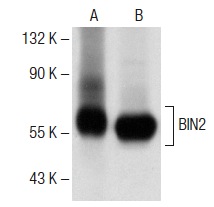
Western blot analysis of BIN2 expression in mouse spleen (A) and rat spleen (B) tissue extracts.| Product Name | BIN2 Antibody (H-70) |
|---|---|
| Antibody Type | Primary Antibodies |
| Modification Notes | BAR proteins are characterized by a common N-terminal BAR (bin, amphiphysin and Rvs161/167) domain and are recognized as adaptor proteins that are involved in many cellular processes. BIN1 and BIN2 are BAR proteins that share 61% sequence similarity. BIN1 (Bridging integrator 1) is a ubiquitously expressed regulatory protein for synaptic vesicle endocytosis. BIN1 also interacts with the transcription factors c-Myc and MyoD, potentially functioning as a tumor suppressor. BIN2, also known as Breast cancer-associated protein 1, is a 565 amino acid protein that interacts with BIN1. In contrast to BIN1, BIN2 lacks tumor suppressor features as well as a c-Myc interacting region. BIN2 shows preferred expression in tissues of hematopoietic origin, with high levels found in spleen, thymus, colon, placenta, lymphoid and granulocytic cells. There are two isoforms of BIN2 that are produced as a result of alternative splicing events. |
| Clonality | Polyclonal |
|---|---|
| Isotype | IgG |
| Host Species | Rabbit |
| Tested Applications | WBIPIFELISA |
| recommended for detection of BIN2 of mouse, rat and human origin by WB, IP, IF and ELISA also reactive with additional species, including equine, canine and bovine | |
| Species Reactivity | HumanMouseRat |
| Concentration | 1mg/ml |
| Purification | Affinity purified |
| Alternative Names | epitope corresponding to amino acids 40-109 mapping near the N-terminus of BIN2 of human origin |
|---|---|
| Tissue Specificity | epitope corresponding to amino acids 40-109 mapping near the N-terminus of BIN2 of human origin |
Application
Western blot analysis of BIN2 expression in mouse spleen (A) and rat spleen (B) tissue extracts.| Application Notes | recommended for detection of BIN2 of mouse, rat and human origin by WB, IP, IF and ELISA also reactive with additional species, including equine, canine and bovine |
|---|
| Form | Liquid |
|---|---|
| Storage Instructions | For short-term storage, store at 4° C. For long-term storage, aliquot and store at -20ºC or below. Avoid multiple freeze-thaw cycles. |
| Storage Buffer | phosphate buffered saline , pH 7.4, 150mM NaCl, 0.02% sodium azide and 50% glycerol. |


