Application
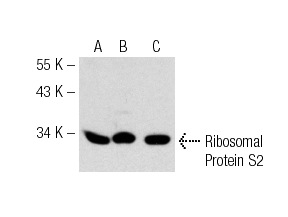
Western blot analysis of Ribosomal Protein S2 expression in Jurkat (A), K-562 (B) and HeLa (C) whole cell lysates.| Product Name | Ribosomal Protein S2 Antibody (H-233) |
|---|---|
| Antibody Type | Primary Antibodies |
| Modification Notes | Ribosomal subunits are synthesized in the nucleus, and mature 40S and 60S subunits are exported stoichiometrically into the cytoplasm. Both 40S and 60S subunits are composed of four RNA species and approximately 80 structurally distinct proteins. Mitochondrial ribosomes consist of a small 28S subunit and a large 39S subunit. Ribosomal proteins have the ability to pass through the nuclear envelope in the native state, making them the largest of the structures accommodated by the nuclear pore complexes. The nuclear export of ribosomal subunits is a unidirectional, saturable and energy-dependent process.Ribosomal Protein S2 is part of the 40S subunit that mediates aminoacyl-transfer RNA binding to the ribosome, thereby affecting the fidelity of mRNA translation. Ribosomal Protein S2 is methylated by protein arginine methyltransferase 3 (PRMT3), which may inhibit ubiquitin-mediated proteolysis of Ribosomal Protein S2. Ribosomal Protein S2 expression has been shown to be elevated in human premalignant leukoplakia, head and neck squamous cell carcinomas and colon and breast cancers, making it a potentially useful diagnostic marker for some human tumors. |
| Clonality | Polyclonal |
|---|---|
| Isotype | IgG |
| Host Species | Rabbit |
| Tested Applications | WBIPIFELISA |
| recommended for detection of Ribosomal Protein S2 of mouse, rat and human origin by WB, IP, IF and ELISA also reactive with additional species, including equine, canine, bovine and avian | |
| Species Reactivity | HumanMouseRat |
| Concentration | 1mg/ml |
| Purification | Affinity purified |
| Alternative Names | epitope corresponding to amino acids 61-293 mapping at the C-terminus of Ribosomal Protein S2 of human origin |
|---|---|
| Tissue Specificity | epitope corresponding to amino acids 61-293 mapping at the C-terminus of Ribosomal Protein S2 of human origin |
| Entrez Gene | 6187 |
|---|
Application
Western blot analysis of Ribosomal Protein S2 expression in Jurkat (A), K-562 (B) and HeLa (C) whole cell lysates.| Application Notes | recommended for detection of Ribosomal Protein S2 of mouse, rat and human origin by WB, IP, IF and ELISA also reactive with additional species, including equine, canine, bovine and avian |
|---|
| Form | Liquid |
|---|---|
| Storage Instructions | For short-term storage, store at 4° C. For long-term storage, aliquot and store at -20ºC or below. Avoid multiple freeze-thaw cycles. |
| Storage Buffer | phosphate buffered saline , pH 7.4, 150mM NaCl, 0.02% sodium azide and 50% glycerol. |


