Application
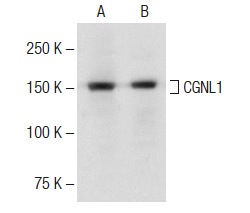
Western blot analysis of CGNL1 expression in TT (A) and NTERA-2 cl.D1 (B) whole cell lysates.| Product Name | CGNL1 Antibody (H-188) |
|---|---|
| Antibody Type | Primary Antibodies |
| Antigen Alias | epitope corresponding to amino acids 770-957 mapping within an internal region of CGNL1 of human origin |
| Modification Notes | Diffusion of solutes is prevented across certain barriers by the formation of tight junction seals. Occludin and Cingulin interact with other proteins to direct the formation and regulation of tight junctions. Cingulin, a protein component of the submembrane plaque of tight junctions (TJ), contains globular and coiled-coil domains and interacts in vitro with several TJ and cytoskeletal proteins, including the PDZ protein ZO-1. CGNL1 (cingulin-like 1), also known as JACOP (junction-associated coiled-coil protein), is a 1.302 amino acid tight junction protein belonging to the Cingulin family. Expressed in smooth muscle, spleen, testis, fetal brain, amygdala, corpus callosum, cerebellum, thalamus and subthalamic nucleus of adult brain. CGNL1 exists as two alternatively spliced isoforms and is encoded by a gene located on human chromosome 15q21.3. CGNL1 may participate in anchoring the apical junctional complex, primarily tight junctions, to actin-based cytoskeletons. Mutations in the gene encoding CGNL1 is the cause of aromatase excess syndrome, which is characterized by an estrogen excess due to an increased aromatase activity. |
| Clonality | Polyclonal |
|---|---|
| Isotype | IgG |
| Host Species | Rabbit |
| Tested Applications | WBIPIFELISA |
| recommended for detection of CGNL1 of mouse, rat and human origin by WB, IP, IF and ELISA: |
|
| Species Reactivity | HumanMouseRat |
| Concentration | 1mg/ml |
| Purification | Affinity purified |
| Alternative Names | epitope corresponding to amino acids 770-957 mapping within an internal region of CGNL1 of human origin |
|---|---|
| Tissue Specificity | epitope corresponding to amino acids 770-957 mapping within an internal region of CGNL1 of human origin |
| Entrez Gene | 84952 |
|---|
Application
Western blot analysis of CGNL1 expression in TT (A) and NTERA-2 cl.D1 (B) whole cell lysates.| Application Notes | recommended for detection of CGNL1 of mouse, rat and human origin by WB, IP, IF and ELISA: |
|---|
| Form | Liquid |
|---|---|
| Storage Instructions | For short-term storage, store at 4° C. For long-term storage, aliquot and store at -20ºC or below. Avoid multiple freeze-thaw cycles. |
| Storage Buffer | phosphate buffered saline , pH 7.4, 150mM NaCl, 0.02% sodium azide and 50% glycerol. |


