Application
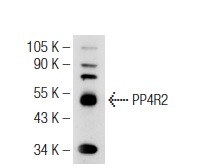
Western blot analysis of PP4R2 expression in HeLa whole cell lysate.| Product Name | PP4R2 Antibody (P-17) |
|---|---|
| Antibody Type | Primary Antibodies |
| Antigen Alias | epitope mapping within an internal region of PP4R2 of human origin |
| Modification Notes | In eukaryotes, the phosphorylation and dephosphorylation of proteins on serine and threonine residues is an essential means of regulating a broad range of cellular functions, including division, homeostasis and apoptosis. A group of proteins that are intimately involved in this process are the protein phosphatases. PP4R2 (Serine/threonine-protein phosphatase 4 regulatory subunit 2) is a 417 amino acid centrosomal protein that regulates PPX, a phosphatase that is involved in many intracellular events. Specifically, PP4R2 regulates PPX at centrosomal microtubule organizing centers, where it targets PPX to this location. PP4R2 interacts with the SMN complex, which leads to the enhancement of temporal localization of small nuclear ribonucleoproteins (snRNPs), suggesting that PP4R2 is involved in the maturation of spliceosomal snRNPs. A complex formed by PPX, PP4R3A and PP4R2 dephosphorylates Histone H2A.X on Ser140. There are three isoforms of PP4R2 that are produced as a result of alternative splicing events. |
| Clonality | Polyclonal |
|---|---|
| Isotype | IgG |
| Host Species | Rabbit |
| Tested Applications | WBIPIFELISA |
| recommended for detection of PP4R2 of mouse, rat and human origin by WB, IP, IF and ELISA also reactive with additional species, including equine, canine, bovine and porcine: |
|
| Species Reactivity | HumanMouseRat |
| Concentration | 1mg/ml |
| Purification | Affinity purified |
| Alternative Names | epitope mapping within an internal region of PP4R2 of human origin |
|---|---|
| Tissue Specificity | epitope mapping within an internal region of PP4R2 of human origin |
| Entrez Gene | 151987 |
|---|
Application
Western blot analysis of PP4R2 expression in HeLa whole cell lysate.| Application Notes | recommended for detection of PP4R2 of mouse, rat and human origin by WB, IP, IF and ELISA also reactive with additional species, including equine, canine, bovine and porcine: |
|---|
| Form | Liquid |
|---|---|
| Storage Instructions | For short-term storage, store at 4° C. For long-term storage, aliquot and store at -20ºC or below. Avoid multiple freeze-thaw cycles. |
| Storage Buffer | phosphate buffered saline , pH 7.4, 150mM NaCl, 0.02% sodium azide and 50% glycerol. |


