Application
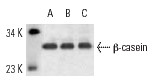
Western blot analysis of β-casein expression in MCF7 (A), BT-20 (B) and MDA-MB-231 (C) whole cell lysates.| Product Name | β-casein Antibody (FL-226) |
|---|---|
| Antibody Type | Primary Antibodies |
| Modification Notes | Milk proteins are crucial for the development of all newborn mammals and caseins constitute the major proteins in mammalian milk. b- and k-caseins are the only caseins present in human milk. The b-casein/k-casein ratio is higher in colostrum than in transitional and mature milk and is related to a better digestibility of colostrum casein micelles by the neonate during the first days of life. Human b-casein-encoding gene (Bca) contains a highly phosphorylated site, which is responsible for the calcium-binding capacity of b-casein. A common set of transcription factors are required for the expression of b-casein. Multiple binding sites for Stat5, C/EBPb (CCAAT/enchancer-binding protein) and several half-sites for glucocorticoid receptor (GR) are identified in the distal human enhancer of the b-casein gene. b-casein gene transcription is regulated primarily by a composite response element (CoRE), which integrates signaling from the lactogenic hormones PRL, insulin and hydrocortisone in mammary epithelial cells. NFkB functions as a negative regulator of b-casein gene expression during pregnancy by interfering with Stat5 tyrosine phosphorylation. |
| Clonality | Polyclonal |
|---|---|
| Isotype | IgG |
| Host Species | Rabbit |
| Tested Applications | WBIPIFELISA |
| recommended for detection of &beta-casein of human origin by WB, IP, IF and ELISA | |
| Species Reactivity | HumanMouseRat |
| Concentration | 1mg/ml |
| Purification | Affinity purified |
| Alternative Names | epitope corresponding to amino acids 1-226 representing full length &beta -casein of human origin |
|---|---|
| Tissue Specificity | epitope corresponding to amino acids 1-226 representing full length β-casein of human origin |
| Entrez Gene | 1447 |
|---|
Application
Western blot analysis of β-casein expression in MCF7 (A), BT-20 (B) and MDA-MB-231 (C) whole cell lysates.| Application Notes | recommended for detection of &beta-casein of human origin by WB, IP, IF and ELISA |
|---|
| Form | Liquid |
|---|---|
| Storage Instructions | For short-term storage, store at 4° C. For long-term storage, aliquot and store at -20ºC or below. Avoid multiple freeze-thaw cycles. |
| Storage Buffer | phosphate buffered saline , pH 7.4, 150mM NaCl, 0.02% sodium azide and 50% glycerol. |


