Application
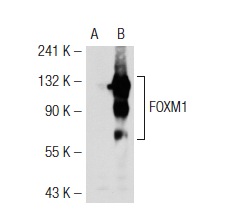
Western blot analysis of FOXM1 expression in non-transfected: (A) and human FOXM1 transfected: (B) 293 whole cell lysates.Application
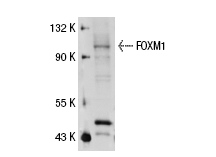
Western blot analysis of FOXM1 expression in U-2 OS whole cell lysate.| Product Name | FOXM1 Antibody (H-92) |
|---|---|
| Antibody Type | Primary Antibodies |
| Modification Notes | The Fox family of transcription factors is a large group of proteins that share a common DNA binding domain termed a winged-helix or forkhead domain. FOXM1, also known as FKHL16, MPP2 or TRIDENT, is primarily expressed in proliferating cells. The gene encoding human FOXM1 maps to chromosome 12p13. The transcription element that restricts FOXM1 expression to proliferating cells is located 300 bp upstream of the start codon. FOXM1 is most abundant in thymus, testis, small intestine and colon. Alternative splicing generates FOXM1A and FOXM1B isoforms that contain PEST regions involved in rapid protein degradation. A decrease in FOXM1 expression is associated with age-related defects in cellular proliferation. Conversely, an increase in FOXM1B expression in the livers of older transgenic mice restore hepatocyte DNA replication rates to the higher rate present in young livers. FOXM1B activates the transcription of cyclin B1, cyclin D1 and Cdc25B. |
| Clonality | Polyclonal |
|---|---|
| Isotype | IgG |
| Host Species | Rabbit |
| Tested Applications | WBIPIFELISAGSChIP |
| recommended for detection of FOXM1 of mouse, rat and human origin by WB, IP, IF and ELISA also reactive with additional species, including canine | |
| Species Reactivity | HumanMouseRat |
| Concentration | 1mg/ml |
| Purification | Affinity purified |
| Alternative Names | epitope corresponding to amino acids 502-801 mapping at the C-terminus of FOXM1 of human origin |
|---|---|
| Tissue Specificity | epitope corresponding to amino acids 502-801 mapping at the C-terminus of FOXM1 of human origin |
| Entrez Gene | 2305 |
|---|
Application
Western blot analysis of FOXM1 expression in non-transfected: (A) and human FOXM1 transfected: (B) 293 whole cell lysates.
Application
Western blot analysis of FOXM1 expression in U-2 OS whole cell lysate.| Application Notes | recommended for detection of FOXM1 of mouse, rat and human origin by WB, IP, IF and ELISA also reactive with additional species, including canine |
|---|
| Form | Liquid |
|---|---|
| Storage Instructions | For short-term storage, store at 4° C. For long-term storage, aliquot and store at -20ºC or below. Avoid multiple freeze-thaw cycles. |
| Storage Buffer | phosphate buffered saline , pH 7.4, 150mM NaCl, 0.02% sodium azide and 50% glycerol. |


