Application
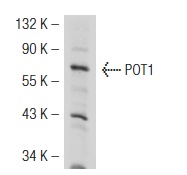
Western blot analysis of POT1 expression in mouse brain tissue extract.| Product Name | POT1 Antibody (H-200) |
|---|---|
| Antibody Type | Primary Antibodies |
| Modification Notes | POT1 (protection of telomeres 1 homolog (S. pombe)) human protein mediates chromosome end-protection and telomere-length regulation and has a strong sequence preference for binding telomeric repeat tracts. POT1 can disrupt telomeric repeat tracts that form intramolecular G-quadruplexes through Hoogsteen base-pairing. POT1 belongs to a family of oligonucleotide-binding (OB)-fold-containing proteins that include Oxytricha nova TEBP, Cdc13 and spPot1, which specifically recognize telomeric single-stranded DNA (ssDNA). Telomere maintenance involves the cooperation of several telomeric factors, including telomerase, TRF1, TRF2, RAP1, TIN2, Tankyrase, PINX1 and POT1. Alterations in POT1 expression levels may be associated with stomach carcinogenesis and GC progression. |
| Clonality | Polyclonal |
|---|---|
| Isotype | IgG |
| Host Species | Rabbit |
| Tested Applications | WBIPIFELISA |
| recommended for detection of POT1 isoforms 1-5 of mouse, rat and human origin by WB, IP, IF and ELISA also reactive with additional species, including equine, canine and bovine | |
| Species Reactivity | HumanMouseRat |
| Concentration | 1mg/ml |
| Purification | Affinity purified |
| Alternative Names | epitope corresponding to amino acids 11-210 mapping near the N-terminus of Protection of Telomeres 1 of human origin |
|---|---|
| Tissue Specificity | epitope corresponding to amino acids 11-210 mapping near the N-terminus of Protection of Telomeres 1 of human origin |
| Entrez Gene | 25913 |
|---|
Application
Western blot analysis of POT1 expression in mouse brain tissue extract.| Application Notes | recommended for detection of POT1 isoforms 1-5 of mouse, rat and human origin by WB, IP, IF and ELISA also reactive with additional species, including equine, canine and bovine |
|---|
| Form | Liquid |
|---|---|
| Storage Instructions | For short-term storage, store at 4° C. For long-term storage, aliquot and store at -20ºC or below. Avoid multiple freeze-thaw cycles. |
| Storage Buffer | phosphate buffered saline , pH 7.4, 150mM NaCl, 0.02% sodium azide and 50% glycerol. |


