Application
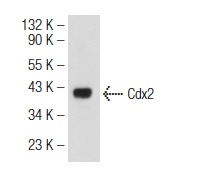
Western blot analysis of Cdx2 expression in COLO 320DM whole cell lysate.| Product Name | Cdx2 Antibody (H-43) |
|---|---|
| Antibody Type | Primary Antibodies |
| Modification Notes | The members of the murine Cdx family (Cdx1, Cdx2, and Cdx4) are members of the caudal-type homeobox family of genes, which are homologues of the Drosophila ‘caudal’ gene required for anterior-posterior regional identity (1). The intestine-specific transcription factors Cdx1 and Cdx2 are candidate genes for directing intestinal development, differentiation, proliferation and maintenance of the intestinal phenotype (2,3). The relative expression of Cdx1 to Cdx2 protein may be important in the anterior to posterior patterning of the intestinal epithelium and in defining patterns of proliferation and differentiation along the crypt-villus axis (2). Expression of the Cdx1 homeobox gene in epithelial intestinal cells promotes cellular growth and differentiation (4). Cdx1 positively regulates its own expression (5). Cdx1 and Cdx2 are expressed in the small intestine and colon of fetus and adult (6). A decrease in human Cdx1 and/or Cdx2 expression is associated with colorectal tumorigenesis (7). Both Cdx1 and Cdx2 genes must be expressed to reduce tumorigenic potential, to increase sensitivity to apoptosis, and to reduce cell migration, suggesting that the two genes control the normal phenotype by independent pathways (8). The human Cdx1 gene maps to chromosome 5q32 and encodes a 265-amino acid protein (9). |
| Clonality | Polyclonal |
|---|---|
| Isotype | IgG |
| Host Species | Rabbit |
| Tested Applications | WBIPIFELISA |
| recommended for detection of Cdx2 of mouse, rat and human origin by WB, IP, IF and ELISA | |
| Species Reactivity | HumanMouseRat |
| Concentration | 1mg/ml |
| Purification | Affinity purified |
| Alternative Names | epitope corresponding to amino acids 271-313 mapping at the C-terminus of Cdx2 of human origin |
|---|---|
| Tissue Specificity | epitope corresponding to amino acids 271-313 mapping at the C-terminus of Cdx2 of human origin |
| Entrez Gene | 1045 |
|---|
Application
Western blot analysis of Cdx2 expression in COLO 320DM whole cell lysate.| Application Notes | recommended for detection of Cdx2 of mouse, rat and human origin by WB, IP, IF and ELISA |
|---|
| Form | Liquid |
|---|---|
| Storage Instructions | For short-term storage, store at 4° C. For long-term storage, aliquot and store at -20ºC or below. Avoid multiple freeze-thaw cycles. |
| Storage Buffer | phosphate buffered saline , pH 7.4, 150mM NaCl, 0.02% sodium azide and 50% glycerol. |


