Application
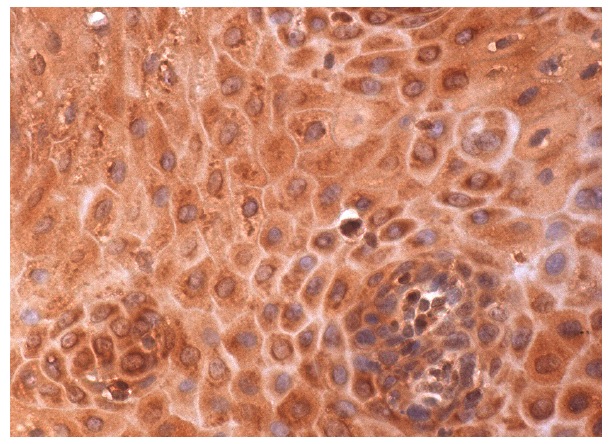
Immunoperoxidase staining of formalin fixed, paraffin-embedded human esophagus tissue showing cytoplasmic and nuclear staining of squamous epithelial cells.| Product Name | TMEM16B Antibody (H-73) |
|---|---|
| Antibody Type | Primary Antibodies |
| Modification Notes | TMEM16B (transmembrane protein 16B), also known as ANO2 (anoctamin 2) or C12orf3, is a 999 amino acid multi-pass membrane protein that shares 54% sequence similarity with TMEM16A, a related family member. Defects in the gene encoding TMEM16B may be associated with von Willebrand disease type 3, an inherited autosomal recessive disorder that is characterized by errors in platelet adhesion. The gene encoding TMEM16B maps to chromosome 12, which encodes over 1,100 genes and comprises approximately 4.5% of the human genome. Chromosome 12 is associated with a variety of diseases and afflictions, including hypochondrogenesis, achondrogenesis, Kniest dysplasia, Noonan syndrome and Trisomy 12p, which causes facial developmental defects and seizure disorders. |
| Clonality | Polyclonal |
|---|---|
| Isotype | IgG |
| Host Species | Rabbit |
| Tested Applications | WBIPIFIHCELISA |
| recommended for detection of TMEM16B of mouse, rat and human origin by WB, IP, IF, IHC(P) and ELISA | |
| Species Reactivity | HumanMouseRat |
| Concentration | 1mg/ml |
| Purification | Affinity purified |
| Alternative Names | epitope corresponding to amino acids 931-1003 mapping at the C-terminus of TMEM16B of human origin |
|---|---|
| Tissue Specificity | epitope corresponding to amino acids 931-1003 mapping at the C-terminus of TMEM16B of human origin |
| Entrez Gene | 57101 |
|---|
Application
Immunoperoxidase staining of formalin fixed, paraffin-embedded human esophagus tissue showing cytoplasmic and nuclear staining of squamous epithelial cells.| Application Notes | recommended for detection of TMEM16B of mouse, rat and human origin by WB, IP, IF, IHC(P) and ELISA |
|---|
| Form | Liquid |
|---|---|
| Storage Instructions | For short-term storage, store at 4° C. For long-term storage, aliquot and store at -20ºC or below. Avoid multiple freeze-thaw cycles. |
| Storage Buffer | phosphate buffered saline , pH 7.4, 150mM NaCl, 0.02% sodium azide and 50% glycerol. |


