Application
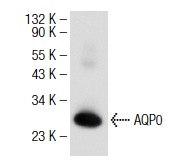
Western blot analysis of AQP0 expression in mouse eye tissue extract.| Product Name | AQP0 Antibody (H-44) |
|---|---|
| Antibody Type | Primary Antibodies |
| Modification Notes | Aquaporins (AQPs) are a large family of integral membrane channel proteins that facilitate the transport of water through the cell membrane. Aquaporins are widely distributed and are involved in renal water absorption, generation of pulmonary secretions, lacrimation, and the secretion and reabsorption of cerebrospinal fluid and aqueous humor. AQP0 is the most abundant endogenous protein in the plasma membrane of lens fiber cells where it functions not only as a water pore, but it is also involved in fiber-fiber adhesion and is crucial for fiber cell structure and organization. AQP0 contains an additional pore constriction, not seen in any other aquaporin structures, which may be responsible for pore gating. The closed AQP0 pore holds just three water molecules, which are spaced too far apart to form hydrogen bonds with each other. The C-terminal domain of AQP0 undergoes extensive post-translational modification, including many truncations, during lens aging due to the actions of m-calpain, proteases, or non-enzymatic mechanisms. These truncation sites may be involved in the development of cataracts. |
| Clonality | Polyclonal |
|---|---|
| Isotype | IgG |
| Host Species | Rabbit |
| Tested Applications | WBIPIFELISA |
| recommended for detection of AQP0 of mouse, rat and human origin by WB, IP, IF and ELISA also reactive with additional species, including equine | |
| Species Reactivity | HumanMouseRat |
| Concentration | 1mg/ml |
| Purification | Affinity purified |
| Alternative Names | epitope corresponding to amino acids 220-263 mapping within a C-terminal cytoplasmic domain of AQP0 of human origin |
|---|---|
| Tissue Specificity | epitope corresponding to amino acids 220-263 mapping within a C-terminal cytoplasmic domain of AQP0 of human origin |
| Entrez Gene | 4284 |
|---|
Application
Western blot analysis of AQP0 expression in mouse eye tissue extract.| Application Notes | recommended for detection of AQP0 of mouse, rat and human origin by WB, IP, IF and ELISA also reactive with additional species, including equine |
|---|
| Form | Liquid |
|---|---|
| Storage Instructions | For short-term storage, store at 4° C. For long-term storage, aliquot and store at -20ºC or below. Avoid multiple freeze-thaw cycles. |
| Storage Buffer | phosphate buffered saline , pH 7.4, 150mM NaCl, 0.02% sodium azide and 50% glycerol. |


