Application
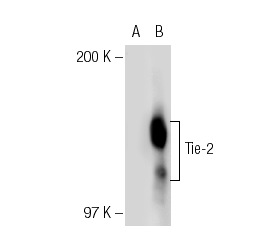
Western blot analysis of Tie-2 expression in non-transfected: (A) and human Tie-2 transfected: (B) 293T whole cell lysates.Application
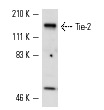
Western blot analysis of Tie-2 expression in HUV-EC-C whole cell lysate.| Product Name | Tie-2 Antibody (C-20) AC |
|---|---|
| Antibody Type | Primary Antibodies |
| Modification Notes | Receptor tyrosine kinases play key roles in signal transduction across cell surfaces in biological systems, including the vascular system. These receptors comprise a large and diverse family of catalytically related proteins that, on the basis of sequence and structural similarities, can be divided into several different evolutionary subfamilies. The cloning and characterization of Tie-1 (also designated Tie), a novel human endothelial cell surface receptor tyrosine kinase, has been reported. The extracellular domain of the predicted Tie-1 protein product has an unusual multidomain structure consisting of a cluster of three epidermal growth factor homology motifs localized between two immunoglobulin-like loops, which are followed by three fibronectin type III repeats next to the transmembrane region. An additional member of this family has been identified as Tie-2 (also designated Tek). Tie-1 and Tie-2 have been shown to be encoded by distinct genes and to represent members of a new class of receptor tyrosine kinases. |
| Clonality | Polyclonal |
|---|---|
| Isotype | IgG |
| Host Species | Rabbit |
| Tested Applications | WBIPIFELISA |
| recommended for detection of Tie-2 and, to a lesser extent, Tie-1 of mouse, rat and human origin by WB, IP, IF and ELISA also reactive with additional species, including equine, canine, bovine, porcine and avian | |
| Species Reactivity | HumanMouseRat |
| Concentration | 1mg/ml |
| Purification | Affinity purified |
| Alternative Names | epitope mapping at the C-terminus of Tie-2 of mouse origin |
|---|---|
| Tissue Specificity | epitope mapping at the C-terminus of Tie-2 of mouse origin |
| Entrez Gene | 7010 |
|---|
Application
Western blot analysis of Tie-2 expression in non-transfected: (A) and human Tie-2 transfected: (B) 293T whole cell lysates.
Application
Western blot analysis of Tie-2 expression in HUV-EC-C whole cell lysate.| Application Notes | recommended for detection of Tie-2 and, to a lesser extent, Tie-1 of mouse, rat and human origin by WB, IP, IF and ELISA also reactive with additional species, including equine, canine, bovine, porcine and avian |
|---|
| Form | Liquid |
|---|---|
| Storage Instructions | For short-term storage, store at 4° C. For long-term storage, aliquot and store at -20ºC or below. Avoid multiple freeze-thaw cycles. |
| Storage Buffer | phosphate buffered saline , pH 7.4, 150mM NaCl, 0.02% sodium azide and 50% glycerol. |


