Application
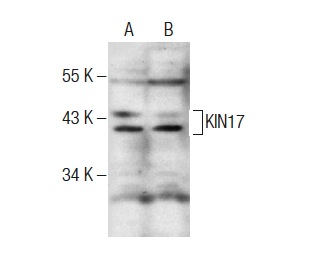
Western blot analysis of KIN17 expression in RKO (A) and HCT 116 (B) whole cell lysates.| Product Name | KIN17 Antibody (H-65) |
|---|---|
| Antibody Type | Primary Antibodies |
| Modification Notes | The KIN17 protein binds to bent or curved double-stranded DNA fragments found at illegitimate recombination sites. KIN17 is ubiqutiously expressed with the highest levels of expression in muscle, heart and testis. Low doses of ionizing radiation increase KIN17 expression in mammalian cells. In keratinocytes, KIN17 expression increases during periods of hyperproliferation. UVC irradiation also increases KIN17 expression when functional XPA and XPC proteins are present. Antisense studies indicate that a decrease in KIN17 correlates with a decrease in cell proliferation and an accumulation of cells in early and mid-S phase. SV40-transformed fibroblasts overexpress KIN17, which interacts with Large T antigen and reduces T-antigen-dependent DNA replication. The gene encoding human KIN17 maps to chromosome 10p14. |
| Clonality | Polyclonal |
|---|---|
| Isotype | IgG |
| Host Species | Rabbit |
| Tested Applications | WBIPIFELISA |
| recommended for detection of KIN17 of mouse, rat and human origin by WB, IP, IF and ELISA also reactive with additional species, including equine, canine and avian | |
| Species Reactivity | HumanMouseRat |
| Concentration | 1mg/ml |
| Purification | Affinity purified |
| Alternative Names | epitope corresponding to amino acids 329-393 mapping at the C-terminus of KIN17 of human origin |
|---|---|
| Tissue Specificity | epitope corresponding to amino acids 329-393 mapping at the C-terminus of KIN17 of human origin |
Application
Western blot analysis of KIN17 expression in RKO (A) and HCT 116 (B) whole cell lysates.| Application Notes | recommended for detection of KIN17 of mouse, rat and human origin by WB, IP, IF and ELISA also reactive with additional species, including equine, canine and avian |
|---|
| Form | Liquid |
|---|---|
| Storage Instructions | For short-term storage, store at 4° C. For long-term storage, aliquot and store at -20ºC or below. Avoid multiple freeze-thaw cycles. |
| Storage Buffer | phosphate buffered saline , pH 7.4, 150mM NaCl, 0.02% sodium azide and 50% glycerol. |


