Application
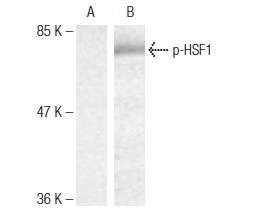
Blots were probed with p-HSF1 (Ser 307): preincubated with cognate phosphorylated peptide (A) and p-HSF1 (Ser 307): (B).| Product Name | p-HSF1 Antibody (Ser 307) |
|---|---|
| Antibody Type | Primary Antibodies |
| Modification Notes | Prokaryotic and eukaryotic cells respond to thermal and chemical stress by inducing a group of genes collectively designated heat shock genes. In eukaryotes, this gene expression is regulated primarily at the transcription level. Heat shock transcription factors (HSF, also designated HSTF) 1 and 2 are involved in this regulation. HSF1 and HSF2 are upregulated by estrogen, at both the mRNA and protein level. HSF1 is normally found as a monomer, whose transcriptional activity is repressed by constitutive phosphorylation. Upon activation, HSF1 forms trimers, gains DNA binding activity and is translocated to the nucleus. HSF2 activity is associated with differentiation and development, and, like HSF1, binds DNA as a trimer. Both HSF1 and HSF2 are known to be induced by proteasome inhibitors of the ubiquitin pathway. Phosphorylation of HSF1 on Ser230 by heat shock has been shown to positively contribute to the transcriptional activity of HSF1. The other phosphorylated serine residues, Ser 303, Ser 307 and Ser 363 have demonstrated repression of transactivation capacity. |
| Clonality | Polyclonal |
|---|---|
| Isotype | IgG |
| Host Species | Rabbit |
| Tested Applications | WBIPIFIHC |
| Species Reactivity | HumanMouseRat |
| Concentration | 1mg/ml |
| Purification | Affinity purified |
| Alternative Names | recommended for detection of Ser 307 phosphorylated HSF1 of human origin by WB IP IF and IHC(P) |
|---|---|
| Tissue Specificity | recommended for detection of Ser 307 phosphorylated HSF1 of human origin by WB, IP, IF and IHC(P) |
| Entrez Gene | 3297 |
|---|
Application
Blots were probed with p-HSF1 (Ser 307): preincubated with cognate phosphorylated peptide (A) and p-HSF1 (Ser 307): (B).| Form | Liquid |
|---|---|
| Storage Instructions | For short-term storage, store at 4° C. For long-term storage, aliquot and store at -20ºC or below. Avoid multiple freeze-thaw cycles. |
| Storage Buffer | phosphate buffered saline , pH 7.4, 150mM NaCl, 0.02% sodium azide and 50% glycerol. |


