Application
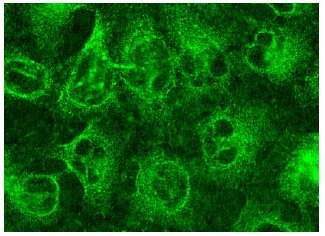
Immunofluorescence staining of methanol-fixed HeLa cells showing membrane localization.Application
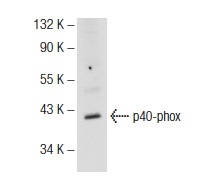
Western blot analysis of p40-phox expression in RAW 264.7 whole cell lysate.| Product Name | p40-phox Antibody (H-300) |
|---|---|
| Antibody Type | Primary Antibodies |
| Modification Notes | Nicotinamide adenine dinucleotide phosphate (NADPH)-oxidase is a multimeric enzyme system that mediates electron transport from NADPH in the cytoplasm to molecular oxygen in the phagosome, thereby generating reactive oxidant intermediates. Upon neutrophil stimulation, NADPH-oxidase and other cytosolic elements localize to the cell membrane from the cytosol to form a complex which produces phagocytic oxygen radicals. There are a number of cytosolic proteins that are involved in NADPH-oxidase activation/ deactivation, including p47-phox, p67-phox, p40-phox and the small GTP-binding protein, Rac. Activation of NADPH oxidase is accompanied by the phosphorylation of cytosolic components p40-phox, p47-phox and p67-phox. The PKC consensus phosphorylation sights Thr 154 and Ser 315 in p40-phox are phosphorylated during activation of NADPH oxidase. p40-phox can promote oxidase activation by increasing the affinity of p47-phox for NADPH-oxidase. However, p40-phox appears to down-regulate oxidase function as well, by competing with an SH3 domain interaction between other essential oxidase components. |
| Clonality | Polyclonal |
|---|---|
| Isotype | IgG |
| Host Species | Rabbit |
| Tested Applications | WBIPIFELISA |
| recommended for detection of p40-phox of mouse, rat and human origin by WB, IP, IF and ELISA also reactive with additional species, including equine, canine, bovine and porcine | |
| Species Reactivity | HumanMouseRat |
| Concentration | 1mg/ml |
| Purification | Affinity purified |
| Alternative Names | epitope corresponding to amino acids 1-300 mapping at the N-terminus of p40-phox of human origin |
|---|---|
| Tissue Specificity | epitope corresponding to amino acids 1-300 mapping at the N-terminus of p40-phox of human origin |
| Entrez Gene | 4689 |
|---|
Application
Immunofluorescence staining of methanol-fixed HeLa cells showing membrane localization.
Application
Western blot analysis of p40-phox expression in RAW 264.7 whole cell lysate.| Application Notes | recommended for detection of p40-phox of mouse, rat and human origin by WB, IP, IF and ELISA also reactive with additional species, including equine, canine, bovine and porcine |
|---|
| Form | Liquid |
|---|---|
| Storage Instructions | For short-term storage, store at 4° C. For long-term storage, aliquot and store at -20ºC or below. Avoid multiple freeze-thaw cycles. |
| Storage Buffer | phosphate buffered saline , pH 7.4, 150mM NaCl, 0.02% sodium azide and 50% glycerol. |


