Application
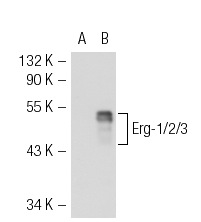
Western blot analysis of Erg-1/2/3 expression in non-transfected: (A) and human Erg-1/2/3 transfected: (B) 293T whole cell lysates.Application
Western blot analysis of Erg-3 expression in Jurkat nuclear extract.| Product Name | Erg-1/2/3 Antibody (H-95) |
|---|---|
| Antibody Type | Primary Antibodies |
| Modification Notes | Ets-1 is the prototype member of a family of genes identified on the basis of homology to the v-Ets oncogene isolated from the E26 erythroblastosis virus. This family of genes currently includes Ets-1, Ets-2, Erg-1–3, Elk-1, Elf-1, Elf-5, NERF, PU.1, PEA3, ERM, FEV, ER8l, Fli-1, TEL, Spi-B, ESE-1, ESE-3A, Net, ABT1 and ERF. Members of the Ets gene family exhibit varied patterns of tissue expression, and share a highly conserved carboxy-terminal domain containing a sequence related to the SV40 large T antigen nuclear localization signal sequence. This conserved domain is essential for Ets-1 binding to DNA and is likely to be responsible for the DNA binding activity of all members of the Ets gene family. Several of these proteins have been shown to recognize similar motifs in DNA that share a centrally located 5'-GGAA-3' element. Erg genes encode for multiple proteins due to alternative splicing and alternative usage of initiation codons. |
| Clonality | Polyclonal |
|---|---|
| Isotype | IgG |
| Host Species | Rabbit |
| Tested Applications | WBIPIFELISAGSChIP |
| recommended for detection of Erg-1, Erg-2 and Erg-3 of mouse, rat and human origin by WB, IP, IF and ELISA also reactive with additional species, including equine, canine, bovine, porcine and avian | |
| Species Reactivity | HumanMouseRat |
| Concentration | 1mg/ml |
| Purification | Affinity purified |
| Alternative Names | epitope corresponding to amino acids 26-120 of Erg-1 of human origin |
|---|---|
| Tissue Specificity | epitope corresponding to amino acids 26-120 of Erg-1 of human origin |
| Entrez Gene | 2078 |
|---|
Application
Western blot analysis of Erg-1/2/3 expression in non-transfected: (A) and human Erg-1/2/3 transfected: (B) 293T whole cell lysates.
Application
Western blot analysis of Erg-3 expression in Jurkat nuclear extract.| Application Notes | recommended for detection of Erg-1, Erg-2 and Erg-3 of mouse, rat and human origin by WB, IP, IF and ELISA also reactive with additional species, including equine, canine, bovine, porcine and avian |
|---|
| Form | Liquid |
|---|---|
| Storage Instructions | For short-term storage, store at 4° C. For long-term storage, aliquot and store at -20ºC or below. Avoid multiple freeze-thaw cycles. |
| Storage Buffer | phosphate buffered saline , pH 7.4, 150mM NaCl, 0.02% sodium azide and 50% glycerol. |


