Application
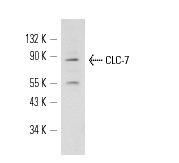
Western blot analysis of CLC-7 expression in NTERA-2 cl.D1 whole cell lysate.| Product Name | CLC-7 Antibody (H-90) |
|---|---|
| Antibody Type | Primary Antibodies |
| Modification Notes | The family of voltage-dependent chloride channels (CLCs) regulate cellular trafficking of chloride ions, a critical component of all living cells. CLCs regulate excitability in muscle and nerve cells, aid in organic solute transport and maintain cellular volume. The genes encoding human CLC-1 through CLC-7 map to chromosomes 7q32, 3q28, 4q32, Xp22.3, Xp11.23-p11.22, 1p36 and 16p13, respectively. CLC1 is highly expressed in skeletal muscle. Mutations in the gene encoding CLC1 lead to myotonia, an inheritable disorder characterized by muscle stiffness and renal salt wasting. CLC2 is highly expressed in the epithelia of several organs including lung, which suggests CLC2 may be a possible therapeutic target for cystic fibrosis. CLC3 expression is particularly abundant in neuronal tissue, while CLC4 expression is evident in skeletal and cardiac muscle as well as brain. Mutations in the gene encoding CLC5 lead to Dent’s disease, a renal disorder characterized by proteinuria and hypercalciuria. CLC6 and CLC7 are broadly expressed in several tissues including testis, kidney, brain and muscle. |
| Clonality | Polyclonal |
|---|---|
| Isotype | IgG |
| Host Species | Rabbit |
| Tested Applications | WBIPIFELISA |
| recommended for detection of CLC-7 of mouse, rat and human origin by WB, IP, IF and ELISA | |
| Species Reactivity | HumanMouseRat |
| Concentration | 1mg/ml |
| Purification | Affinity purified |
| Alternative Names | epitope corresponding to amino acids 1-90 (deletion 23-45) mapping at the N-terminus of CLC-7 of human origin |
|---|---|
| Tissue Specificity | epitope corresponding to amino acids 1-90 (deletion 23-45) mapping at the N-terminus of CLC-7 of human origin |
| Entrez Gene | 1186 |
|---|
Application
Western blot analysis of CLC-7 expression in NTERA-2 cl.D1 whole cell lysate.| Application Notes | recommended for detection of CLC-7 of mouse, rat and human origin by WB, IP, IF and ELISA |
|---|
| Form | Liquid |
|---|---|
| Storage Instructions | For short-term storage, store at 4° C. For long-term storage, aliquot and store at -20ºC or below. Avoid multiple freeze-thaw cycles. |
| Storage Buffer | phosphate buffered saline , pH 7.4, 150mM NaCl, 0.02% sodium azide and 50% glycerol. |


