Application
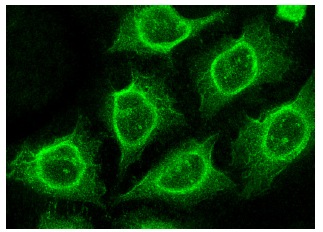
Immunofluorescence staining of methanol-fixed HelLa cells showing membrane localization.Application
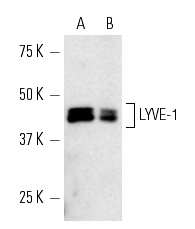
Western blot analysis of LYVE-1 expression in Hs 294T (A) and SK-N-MC (B) whole cell lysates.| Product Name | LYVE-1 Antibody (H-156) |
|---|---|
| Antibody Type | Primary Antibodies |
| Modification Notes | Lymphatic vessel endothelial hyaluronan receptor-1 (LYVE-1) is expressed on the cell surface as a protein that is reduced by glycosidase treatment. LYVE-1 is abundant in spleen, lymph node, heart, lung and fetal liver, and is less abundant in appendix, bone marrow, placenta, muscle and adult liver. Expression of LYVE-1 is largely restricted to endothelial cells lining lymphatic vessels and splenic sinusoidal endothelial cells. LYVE-1 binds to both soluble and immobilized hyaluronan (HA) with greater specificity than HCAM. Like HCAM, the LYVE-1 molecule binds both soluble and immobilized HA. However, unlike HCAM, the LYVE-1 molecule co-localizes with HA on the luminal face of the lymph vessel wall and is completely absent from blood vessels. Hence, LYVE-1 is the first lymph-specific HA receptor to be characterized and is a uniquely powerful marker for lymph vessels themselves. LYVE-1 is used as a marker to study tumor lymphangiogenesis, which is an important area of investigation. |
| Clonality | Polyclonal |
|---|---|
| Isotype | IgG |
| Host Species | Rabbit |
| Tested Applications | WBIPIFELISA |
| recommended for detection of LYVE-1 of mouse, rat and human origin by WB, IP, IF and ELISA | |
| Species Reactivity | HumanMouseRat |
| Concentration | 1mg/ml |
| Purification | Affinity purified |
| Alternative Names | epitope corresponding to amino acids 167-322 mapping at the C-terminus of LYVE-1 of human origin |
|---|---|
| Tissue Specificity | epitope corresponding to amino acids 167-322 mapping at the C-terminus of LYVE-1 of human origin |
| Entrez Gene | 10894 |
|---|
Application
Immunofluorescence staining of methanol-fixed HelLa cells showing membrane localization.
Application
Western blot analysis of LYVE-1 expression in Hs 294T (A) and SK-N-MC (B) whole cell lysates.| Application Notes | recommended for detection of LYVE-1 of mouse, rat and human origin by WB, IP, IF and ELISA |
|---|
| Form | Liquid |
|---|---|
| Storage Instructions | For short-term storage, store at 4° C. For long-term storage, aliquot and store at -20ºC or below. Avoid multiple freeze-thaw cycles. |
| Storage Buffer | phosphate buffered saline , pH 7.4, 150mM NaCl, 0.02% sodium azide and 50% glycerol. |


