Application
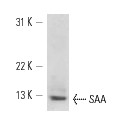
Western blot analysis of human recombinant SAA.| Product Name | SAA Antibody (H-84) |
|---|---|
| Antibody Type | Primary Antibodies |
| Modification Notes | The serum amyloid A (SAA) family of proteins is encoded by multiple genes, which display allelic variation and a high degree of homology in mammals. The four members of the SAA gene family are clustered on human chromosome 11p15.1. Three SAA genes are differentially expressed and encode small apolipoproteins. SAA1 and SAA2 encode the acute phase SAAs (A-SAAs), and SAA4 encodes the constitutively expressed SAA (C-SAA). A fourth locus, SAA3 is a pseudogene that contains two C/EBP-binding sites and a third site, which interacts with SAA3 enhancer factor. Human SAA proteins are a group of apolipoproteins found predominantly in the high-density lipoprotein (HDL) fraction of plasma. SAA is a major acute-phase protein and precursor to amyloid A protein, which is the major constituent of the fibril deposits of reactive amyloidosis. SAA is secreted in large amounts by the liver during microbial infections or inflammatory diseases. |
| Clonality | Polyclonal |
|---|---|
| Isotype | IgG |
| Host Species | Rabbit |
| Tested Applications | WBIPIFELISA |
| recommended for detection of SAA1 and 2 of human origin and SAA3 of mouse origin by WB, IP, IF and ELISA | |
| Species Reactivity | HumanMouseRat |
| Concentration | 1mg/ml |
| Purification | Affinity purified |
| Alternative Names | epitope corresponding to amino acids 38-122 of serum amyloid A precursor (SAA) of human origin |
|---|---|
| Tissue Specificity | epitope corresponding to amino acids 38-122 of serum amyloid A precursor (SAA) of human origin |
| Entrez Gene | 6288 |
|---|
Application
Western blot analysis of human recombinant SAA.| Application Notes | recommended for detection of SAA1 and 2 of human origin and SAA3 of mouse origin by WB, IP, IF and ELISA |
|---|
| Form | Liquid |
|---|---|
| Storage Instructions | For short-term storage, store at 4° C. For long-term storage, aliquot and store at -20ºC or below. Avoid multiple freeze-thaw cycles. |
| Storage Buffer | phosphate buffered saline , pH 7.4, 150mM NaCl, 0.02% sodium azide and 50% glycerol. |


