Application
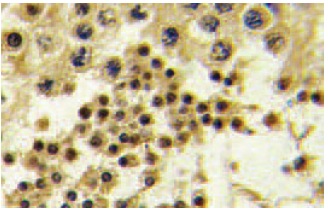
Immunoperoxidase staining of formalin-fixed, paraffin-embedded human testis tissue showing nuclear and cytoplasmic localization.Application
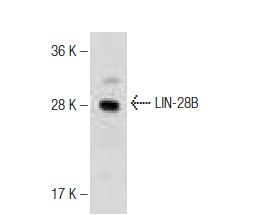
Western blot analysis of LIN-28B expression in K-562 whole cell lysate.| Product Name | LIN-28B Antibody (F-21) |
|---|---|
| Antibody Type | Primary Antibodies |
| Antigen Alias | recommended for detection of LIN-28B of human origin by WB, IP, IF, IHC(P) and ELISA |
| Modification Notes | LIN-28B, also known as CSDD2, is a 250 amino acid protein that localizes to the cytoplasm during the early stages of the cell cycle and translocates to the nucleus during the S and G2 phases of the cell cycle. Expressed at high levels in placenta, testis and fetal liver, LIN-28B contains one cold-shock domain and two CCHC-type zinc fingers and is thought to play a role in cell growth, specifically when overexpressed. Overexpression of LIN-28B stimulates the growth of breast adenocarcinoma and hepatocellular carcinoma cells, implying a role for LIN-28B in aberrant cell proliferation and metastasis. LIN-28B exists as multiple alternatively spliced isoforms which are encoded by a gene that maps to human chromosome 6. Chromosome 6 contains 170 million base pairs and comprises nearly 6% of the human genome. Deletion of a portion of the q arm of chromosome 6 is associated with early onset intestinal cancer, suggesting the presence of a cancer susceptibility locus. Additionally, Porphyria cutanea tarda, Parkinson's disease, Stickler syndrome and a susceptibility to bipolar disorder are all associated with genes that map to chromosome 6. |
| Clonality | Polyclonal |
|---|---|
| Isotype | IgG |
| Host Species | Rabbit |
| Tested Applications | WBIPIFIHCELISA |
| WB:1:500~1:2000 IP:1:100~1:500 IF:1:200~1:500 IHC:1:50~1:200 Notes:Optimal dilutions/concentrations should be determined by the researcher. |
|
| Species Reactivity | HumanMouseRat |
| Concentration | 1mg/ml |
| Purification | Affinity purified |
| Alternative Names | recommended for detection of LIN-28B of human origin by WB IP IF IHC(P) and ELISA |
|---|---|
| Tissue Specificity | recommended for detection of LIN-28B of human origin by WB, IP, IF, IHC(P) and ELISA |
| Entrez Gene | 389421 |
|---|
Application
Immunoperoxidase staining of formalin-fixed, paraffin-embedded human testis tissue showing nuclear and cytoplasmic localization.
Application
Western blot analysis of LIN-28B expression in K-562 whole cell lysate.| Application Notes | WB:1:500~1:2000 IP:1:100~1:500 IF:1:200~1:500 IHC:1:50~1:200 Notes:Optimal dilutions/concentrations should be determined by the researcher. |
|---|
| Form | Liquid |
|---|---|
| Storage Instructions | For short-term storage, store at 4° C. For long-term storage, aliquot and store at -20ºC or below. Avoid multiple freeze-thaw cycles. |
| Storage Buffer | phosphate buffered saline , pH 7.4, 150mM NaCl, 0.02% sodium azide and 50% glycerol. |


