Application
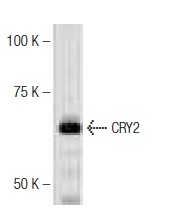
Western blot analysis of CRY2 expression in mouse liver tissue extract.Application
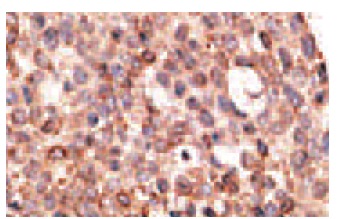
Immunoperoxidase staining of formalin-fixed, paraffin-embedded human breast carcinoma tissue showing cytoplasmic localization.| Product Name | CRY2 Antibody (P-21) |
|---|---|
| Antibody Type | Primary Antibodies |
| Antigen Alias | recommended for detection of CRY2 of mouse and human origin by WB, IP, IF, IHC(P) and ELISA |
| Modification Notes | Circadian clocks are biological timepieces that regulate hormonal rhythms, sleep cycles and feeding behaviors. These rhythms are generated in the superchiasmatic nucleus (SCN), a cell-autonomous circadian oscillator located within the brain that is synchronized with the environment by light. A number of transcription factors, including Clock and BMAL1, are molecular components of the SCN that induce the expression of proteins involved in light/dark cycle entrainment, which include Per1 and Per2. Tim, for timeless, generates a negative feedback loop that regulates the activity of Clock by suppressing the expression of Clock target genes. Tim forms heterodimers with Per1 and Per2 that bind Clock and block the activation of Clock-BMAL1 dimers to repress Per gene expression. Additionally, the CRY proteins, which are cryptochrome photoreceptors for the circadian clock, function as light-independent inhibitors of the circadian clock. CRY1 and CRY2 negatively regulate SCN components by associating with the activators Clock-BMAL1, and also with the various feedback inhibitors Per1, Per2 and Tim. |
| Clonality | Polyclonal |
|---|---|
| Isotype | IgG |
| Host Species | Rabbit |
| Tested Applications | WBIPIFIHCELISA |
| WB:1:500~1:2000 IP:1:100~1:500 IF:1:200~1:500 IHC:1:50~1:200 Notes:Optimal dilutions/concentrations should be determined by the researcher. |
|
| Species Reactivity | HumanMouseRat |
| Concentration | 1mg/ml |
| Purification | Affinity purified |
| Alternative Names | recommended for detection of CRY2 of mouse and human origin by WB IP IF IHC(P) and ELISA |
|---|---|
| Tissue Specificity | recommended for detection of CRY2 of mouse and human origin by WB, IP, IF, IHC(P) and ELISA |
| Entrez Gene | 1408 |
|---|
Application
Western blot analysis of CRY2 expression in mouse liver tissue extract.
Application
Immunoperoxidase staining of formalin-fixed, paraffin-embedded human breast carcinoma tissue showing cytoplasmic localization.| Application Notes | WB:1:500~1:2000 IP:1:100~1:500 IF:1:200~1:500 IHC:1:50~1:200 Notes:Optimal dilutions/concentrations should be determined by the researcher. |
|---|
| Form | Liquid |
|---|---|
| Storage Instructions | For short-term storage, store at 4° C. For long-term storage, aliquot and store at -20ºC or below. Avoid multiple freeze-thaw cycles. |
| Storage Buffer | phosphate buffered saline , pH 7.4, 150mM NaCl, 0.02% sodium azide and 50% glycerol. |


