Application
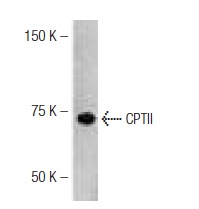
Western blot analysis of CPTII expression in mouse kidney tissue extract.| Product Name | CPTII Antibody (O-25) |
|---|---|
| Antibody Type | Primary Antibodies |
| Antigen Alias | recommended for detection of CPTII of mouse and human origin by WB, IP and ELISA |
| Modification Notes | The mitochondrial ∫-oxidation of long-chain fatty acids is initiated by the sequential action of carnitine palmitoyltransferase (CPT) I (outer membrane and detergent labile) and II (inner membrane and detergent stable), together with carnitine carrier. CPTI catalyzes the first reaction in the transport of long-chain fatty acids from the cytoplasm to the mitochondrion, a rate-limiting step in beta-oxidation. Two types of CPTI are known, the liver (CPTIA) and muscle (CPTIB) isoforms. The muscle type protein is specially expressed in heart and skeletal muscle. Membrane-bound CPTI, but not CPTII, is inhibited reversibly by malonyl-coenzyme A (CoA). Unlike CPTII, CPTI requires membrane integrity for catalytic function. In addition, glutamic acid 3 and histidine 5 are necessary for malonyl CoA inhibition and binding to liver CPTI, but not for catalytic activity. |
| Clonality | Polyclonal |
|---|---|
| Isotype | IgG |
| Host Species | Rabbit |
| Tested Applications | WBIPELISA |
| WB:1:500~1:2000 IP:1:100~1:500 Notes:Optimal dilutions/concentrations should be determined by the researcher. |
|
| Species Reactivity | HumanMouseRat |
| Concentration | 1mg/ml |
| Purification | Affinity purified |
| Alternative Names | recommended for detection of CPTII of mouse and human origin by WB IP and ELISA |
|---|---|
| Tissue Specificity | recommended for detection of CPTII of mouse and human origin by WB, IP and ELISA |
| Entrez Gene | 1376 |
|---|
Application
Western blot analysis of CPTII expression in mouse kidney tissue extract.| Application Notes | WB:1:500~1:2000 IP:1:100~1:500 Notes:Optimal dilutions/concentrations should be determined by the researcher. |
|---|
| Form | Liquid |
|---|---|
| Storage Instructions | For short-term storage, store at 4° C. For long-term storage, aliquot and store at -20ºC or below. Avoid multiple freeze-thaw cycles. |
| Storage Buffer | phosphate buffered saline , pH 7.4, 150mM NaCl, 0.02% sodium azide and 50% glycerol. |


