Application
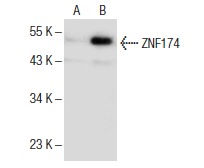
Western blot analysis of ZNF174 expression in non-transfected (A) and human ZNF174 transfected (B) whole cell lysates.Application
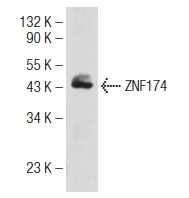
Western blot analysis of ZNF174 expression in SW-13 whole cell lysate.| Product Name | ZNF174 Antibody (H-77) |
|---|---|
| Antibody Type | Primary Antibodies |
| Modification Notes | ZNF174, also known as ZSCAN8 or AW-1, is a transcriptional repressor that belongs to the Krüppel C2H2-type zinc-finger protein family. It is expressed in a number of different tissues, including small intestine, prostate, colon, spleen, pancreas, skeletal muscle, brain, heart, kidney and thymus, but it is most predominantly found in adult ovary and testis. ZNF174 specifically acts to repress the promoter activities of PDGF-B and TGF∫1. ZNF174 localizes to the nucleus and contains three C2H2-type zinc fingers at the C-terminus and one SCAN domain near the N-terminus. SCAN domains are found in a number of zinc finger proteins and are characterized by a conserved region of 84 residues. The SCAN domain seemingly regulates the association of proteins containing SCAN domains into noncovalent complexes and may also function as an underlying mechanism in selective oligomerization of these proteins. |
| Clonality | Polyclonal |
|---|---|
| Isotype | IgG |
| Host Species | Rabbit |
| Tested Applications | WBIPIFELISA |
| recommended for detection of ZNF174 of mouse, rat and human origin by WB, IP, IF and ELISA also reactive with additional species, including equine, canine and porcine | |
| Species Reactivity | HumanMouseRat |
| Concentration | 1mg/ml |
| Purification | Affinity purified |
| Alternative Names | epitope corresponding to amino acids 107-180 mapping within an internal region of ZNF174 of human origin |
|---|---|
| Tissue Specificity | epitope corresponding to amino acids 107-180 mapping within an internal region of ZNF174 of human origin |
| Entrez Gene | 7727 |
|---|
Application
Western blot analysis of ZNF174 expression in non-transfected (A) and human ZNF174 transfected (B) whole cell lysates.
Application
Western blot analysis of ZNF174 expression in SW-13 whole cell lysate.| Application Notes | recommended for detection of ZNF174 of mouse, rat and human origin by WB, IP, IF and ELISA also reactive with additional species, including equine, canine and porcine |
|---|
| Form | Liquid |
|---|---|
| Storage Instructions | For short-term storage, store at 4° C. For long-term storage, aliquot and store at -20ºC or below. Avoid multiple freeze-thaw cycles. |
| Storage Buffer | phosphate buffered saline , pH 7.4, 150mM NaCl, 0.02% sodium azide and 50% glycerol. |


