Application
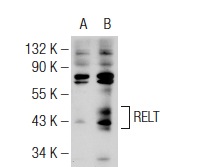
Western blot analysis of RELT expression in non-transfected: (A) and human RELT transfected: (B) 293T whole cell lysates.| Product Name | RELT Antibody (H-220) |
|---|---|
| Antibody Type | Primary Antibodies |
| Modification Notes | RELT (receptor expressed in lymphoid tissues), also known as tumor necrosis factor receptor superfamily member 19L (TNFRSF19L) is a transmembrane glycoprotein. It is expressed in thymus, spleen, testis, colon, skeletal muscle and peripheral blood lymphocytes. RELT contains two cysteine rich domains (although one is incomplete) and does not contain the death domain that is present in some of the TNFR family members. Unlike the other family members that also lack the death domain, RELT does not bind the TRAF adaptor proteins. RELT binds and is phosphorylated by SPAK. This interaction is required for the activation of p38 and JNK signaling. RELT also interacts with, and is phosphorylated by, OSR1 kinase. In addition, RELT may be involved in T-cell activation. The overexpression of RELT induces phosphorylation of c-Jun and ATF2. This implies the activation of the JNK and p38 signaling cascades. |
| Clonality | Polyclonal |
|---|---|
| Isotype | IgG |
| Host Species | Rabbit |
| Tested Applications | WBIPIFELISA |
| recommended for detection of RELT of mouse, rat and human origin by WB, IP, IF and ELISA also reactive with additional species, including equine, canine and bovine | |
| Species Reactivity | HumanMouseRat |
| Concentration | 1mg/ml |
| Purification | Affinity purified |
| Alternative Names | epitope corresponding to amino acids 129-348 mapping within an internal region of RELT of human origin |
|---|---|
| Tissue Specificity | epitope corresponding to amino acids 129-348 mapping within an internal region of RELT of human origin |
| Entrez Gene | 84957 |
|---|
Application
Western blot analysis of RELT expression in non-transfected: (A) and human RELT transfected: (B) 293T whole cell lysates.| Application Notes | recommended for detection of RELT of mouse, rat and human origin by WB, IP, IF and ELISA also reactive with additional species, including equine, canine and bovine |
|---|
| Form | Liquid |
|---|---|
| Storage Instructions | For short-term storage, store at 4° C. For long-term storage, aliquot and store at -20ºC or below. Avoid multiple freeze-thaw cycles. |
| Storage Buffer | phosphate buffered saline , pH 7.4, 150mM NaCl, 0.02% sodium azide and 50% glycerol. |


