Application
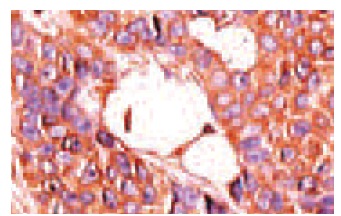
Immunoperoxidase staining of formalin-fixed, paraffin-embedded human breast carcinoma tissue showing cytoplasmic and membrane localization.Application
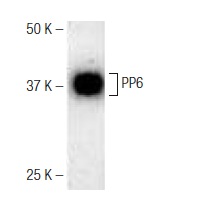
Western blot analysis of PP6 expression in mouse thymus tissue extract.| Product Name | PP6 Antibody (S-22) |
|---|---|
| Antibody Type | Primary Antibodies |
| Modification Notes | In eukaryotes, the phosphorylation and dephosphorylation of proteins on serine and threonine residues is an essential means of regulating a broad range of cellular functions including division, homeostasis and apoptosis. A group of proteins that are intimately involved in this process are the protein phosphatases. In general, the protein phosphatase (PP) holoenzyme is a trimeric complex composed of a regulatory subunit, a variable subunit and a catalytic subunit. Four major families of protein phosphatase catalytic subunit have been identified, designated PP1, PP2A, PP2B and PP2C. An additional protein phosphatase catalytic subunit, PPX (also known as PP4), is a putative member of a novel PP family. PP6 (protein phosphatase 6), also known as PPP6C, is a 305 amino acid cytoplasmic protein that belongs to the PPP phosphatase family. Ubiquitously expressed, PP6 is component of a signaling pathway regulating cell cycle progression in response to IL-2 receptor stimulation and is involved in suppressing inflammatory responses by specifically down-regulating TR4. |
| Clonality | Polyclonal |
|---|---|
| Isotype | IgG |
| Host Species | Rabbit |
| Tested Applications | ELISAIFIHCIPWB |
| WB:1:100~1:200 IP:1:20~1:100 IF:1:20~1:100 IHC:1:10~1:50 |
|
| Species Reactivity | HumanMouseRat |
| Concentration | 1mg/ml |
| Purification | Affinity purified |
| Tissue Specificity | recommended for detection of PP6 of human origin by WB, IP, IF, IHC(P) and ELISA |
|---|
| Entrez Gene | 5537 |
|---|
Application
Immunoperoxidase staining of formalin-fixed, paraffin-embedded human breast carcinoma tissue showing cytoplasmic and membrane localization.
Application
Western blot analysis of PP6 expression in mouse thymus tissue extract.| Application Notes | WB:1:100~1:200 IP:1:20~1:100 IF:1:20~1:100 IHC:1:10~1:50 |
|---|
| Form | Liquid |
|---|---|
| Storage Instructions | For short-term storage, store at 4° C. For long-term storage, aliquot and store at -20ºC or below. Avoid multiple freeze-thaw cycles. |
| Storage Buffer | phosphate buffered saline , pH 7.4, 150mM NaCl, 0.02% sodium azide and 50% glycerol. |


