Application
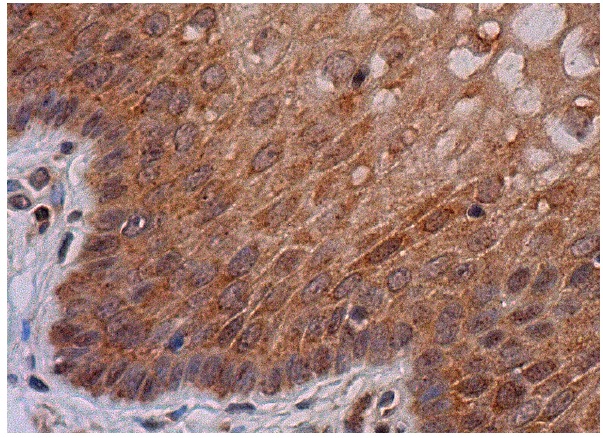
Immunoperoxidase staining of formalin fixed, paraffin-embedded human vagina tissue showing cytoplasmic staining of squamous epithelial cells.| Product Name | ADM2 Antibody (G-13) |
|---|---|
| Antibody Type | Primary Antibodies |
| Antigen Alias | epitope mapping near the C-terminus of ADM2 of human origin |
| Modification Notes | Adrenomedullin (ADM), a vasodilator produced by most contractile cells, is characterized by persistent hypotensive activity. ADM is involved in the regulation of fluid and electrolyte homeostasis and in the maintenance of cardiovascular functioning. In hypertensive patients, the level of ADM in plasma is up-regulated. Natriuresis is a common systemic manifestation of aneurysmal subarachnoid hemorrhage. ADM has strong natriuretic actions. ADM-induced natriuresis is caused by an increase in glomerular filtration rate and a decrease in distal tubular sodium reabsorption. ADM is present both in the periphery and brain, and can exert central effects such as decreasing food ingestion. ADM2 (Adrenomedullin-2), also known as AM2, IMDS or IMDL, is a 148 amino acid secreted protein that belongs to the Adrenomedullin family of calcitonin-related peptide hormones and is expressed in the esophagus, stomach, jejunum, ileum, ileocecum, ascending colon, transverse colon, descending colon and rectum. ADM2 activates the cAMP-dependent pathway and may play a role in regulating gastrointestinal and cardiovascular bioactivities. |
| Clonality | Polyclonal |
|---|---|
| Isotype | IgG |
| Host Species | Rabbit |
| Tested Applications | WBIFIHCELISA |
| recommended for detection of ADM2 of mouse, rat and human origin by WB, IF, IHC(P) and ELISA: |
|
| Species Reactivity | HumanMouseRat |
| Concentration | 1mg/ml |
| Purification | Affinity purified |
| Alternative Names | epitope mapping near the C-terminus of ADM2 of human origin |
|---|---|
| Tissue Specificity | epitope mapping near the C-terminus of ADM2 of human origin |
| Entrez Gene | 79924 |
|---|
Application
Immunoperoxidase staining of formalin fixed, paraffin-embedded human vagina tissue showing cytoplasmic staining of squamous epithelial cells.| Application Notes | recommended for detection of ADM2 of mouse, rat and human origin by WB, IF, IHC(P) and ELISA: |
|---|
| Form | Liquid |
|---|---|
| Storage Instructions | For short-term storage, store at 4° C. For long-term storage, aliquot and store at -20ºC or below. Avoid multiple freeze-thaw cycles. |
| Storage Buffer | phosphate buffered saline , pH 7.4, 150mM NaCl, 0.02% sodium azide and 50% glycerol. |


