Application
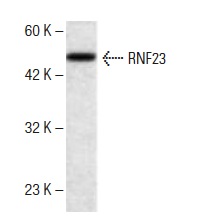
Western blot analysis of RNF23 expression in Hep G2 whole cell lysate.| Product Name | RNF23 Antibody (W-25) |
|---|---|
| Antibody Type | Primary Antibodies |
| Antigen Alias | recommended for detection of RNF23 of human origin by WB, IP and ELISA; also reactive with additional species, including canine |
| Modification Notes | The RING-type zinc finger motif is present in a number of viral and eukaryotic proteins and is made of a conserved cysteine-rich domain that is able to bind two zinc atoms. Proteins that contain this conserved domain are generally involved in the ubiquitination pathway of protein degradation. RNF23 (RING finger protein 23), also known as tripartite motif-containing protein 39 (TRIM39) or testis-abundant finger protein, is a 518 amino acid protein belonging to the TRIM/RBCC family that is known to interact with MOAP1. Ubiquitously expressed and existing as two alternatively spliced isoforms, RNF23 is found at highest levels in spleen, testis, brain, kidney, liver, heart and skeletal muscle. RNF23 typically localizes to cytosol but shifts to mitochondria upon co-localization with MOAP1, a short-lived, pro-apoptotic protein which RNF23 prevents from becoming poly-ubiquitinated and degraded, thereby facilitating apoptosis. RNF23 contains one B box-type zinc finger, a B30.2/SPRY domain and a single RING-type zinc finger. |
| Clonality | Polyclonal |
|---|---|
| Isotype | IgG |
| Host Species | Rabbit |
| Tested Applications | WBIPELISA |
| WB:1:500~1:2000 IP:1:100~1:500 Notes:Optimal dilutions/concentrations should be determined by the researcher. |
|
| Species Reactivity | HumanMouseRat |
| Concentration | 1mg/ml |
| Purification | Affinity purified |
| Alternative Names | recommended for detection of RNF23 of human origin by WB IP and ELISA also reactive with additional species including canine |
|---|---|
| Tissue Specificity | recommended for detection of RNF23 of human origin by WB, IP and ELISA; also reactive with additional species, including canine |
| Entrez Gene | 56658 |
|---|
Application
Western blot analysis of RNF23 expression in Hep G2 whole cell lysate.| Application Notes | WB:1:500~1:2000 IP:1:100~1:500 Notes:Optimal dilutions/concentrations should be determined by the researcher. |
|---|
| Form | Liquid |
|---|---|
| Storage Instructions | For short-term storage, store at 4° C. For long-term storage, aliquot and store at -20ºC or below. Avoid multiple freeze-thaw cycles. |
| Storage Buffer | phosphate buffered saline , pH 7.4, 150mM NaCl, 0.02% sodium azide and 50% glycerol. |


