Application
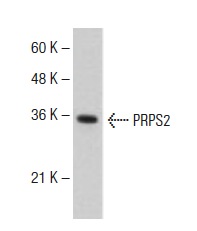
Western blot analysis of PRPS2 expression in Jurkat whole cell lysate.| Product Name | PRPS2 Antibody (L-22) |
|---|---|
| Antibody Type | Primary Antibodies |
| Antigen Alias | recommended for detection of PRPS2 of mouse, rat and human origin by WB, IP and ELISA; also reactive with additional species, including canine |
| Modification Notes | PRPS (phosphoribosyl pyrophosphate synthetase) proteins catalyze the synthesis of phosphoribosyl pyrophosphate (PRPP). Three human PRPS isoforms exist and are encoded by three different genes. PRPS1 and PRPS2 (also known as PRS1 and PRS2, respectively) are ubiquitously expressed, while PRPS3 (also known as PRPS1L1) is specific to the testis. PRPP is an important substrate synthesized from MgATP and ribose-5-phosphate in a reaction that requires inorganic phosphate and magnesium as a cofactor. PRPP is essential in the synthesis of nearly all nucleotides, implying that PRPS proteins play an important role in nucleotide biosynthesis and purine metabolism. PRPS2 is a 318 amino acid protein that exists as a homodimer and a hexamer composed of three homodimers. |
| Clonality | Polyclonal |
|---|---|
| Isotype | IgG |
| Host Species | Rabbit |
| Tested Applications | WBIPELISA |
| WB:1:500~1:2000 IP:1:100~1:500 Notes:Optimal dilutions/concentrations should be determined by the researcher. |
|
| Species Reactivity | HumanMouseRat |
| Concentration | 1mg/ml |
| Purification | Affinity purified |
| Alternative Names | recommended for detection of PRPS2 of mouse rat and human origin by WB IP and ELISA also reactive with additional species including canine |
|---|---|
| Tissue Specificity | recommended for detection of PRPS2 of mouse, rat and human origin by WB, IP and ELISA; also reactive with additional species, including canine |
| Entrez Gene | 5634 |
|---|
Application
Western blot analysis of PRPS2 expression in Jurkat whole cell lysate.| Application Notes | WB:1:500~1:2000 IP:1:100~1:500 Notes:Optimal dilutions/concentrations should be determined by the researcher. |
|---|
| Form | Liquid |
|---|---|
| Storage Instructions | For short-term storage, store at 4° C. For long-term storage, aliquot and store at -20ºC or below. Avoid multiple freeze-thaw cycles. |
| Storage Buffer | phosphate buffered saline , pH 7.4, 150mM NaCl, 0.02% sodium azide and 50% glycerol. |


