Application
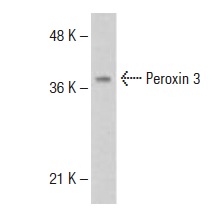
Western blot analysis of Peroxin 3 expression in Hep G2 whole cell lysate.Application
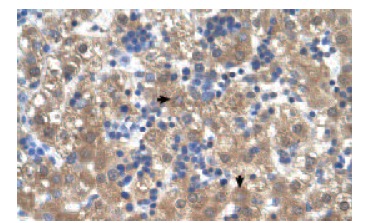
Immunoperoxidase staining of formalin-fixed, paraffin-embedded human liver tissue showing cytoplasmic localization.| Product Name | Peroxin 3 Antibody (F-23) |
|---|---|
| Antibody Type | Primary Antibodies |
| Antigen Alias | recommended for detection of Peroxin 3 of mouse, rat and human origin by WB, IP, IF, IHC(P) and ELISA; also reactive with additional species, including canine |
| Modification Notes | Peroxisomes are single-membrane bound organelles present in virtually all eukaryotic cells. They are involved in numerous catabolic and anabolic pathways, including beta-oxidation of very long chain fatty acids, metabolism of hydrogen peroxide, plasmalogen biosynthesis and bile acid synthesis. The Peroxin family, which includes more than 20 members, is required for peroxisome biogenesis. Peroxin 3, also known as PEX3 (peroxisomal biogenesis factor 3) or TRG18, is a 373 amino acid multi-pass membrane protein that localizes to peroxisomes and belongs to the Peroxin family. Expressed ubiquitously, Peroxin 3 interacts with Peroxin 19 and is involved in peroxisome biosynthesis and membrane vesicle assembly, as well as in the maintenance of peroxisomal integrity. Additionally, Peroxin 3 acts as a docking factor for Peroxin 19 and is required for the import of peroxisomal proteins. Defects in the gene encoding Peroxin 3 are the cause of peroxisome biogenesis disorder complementation group 12 (PBD-CG12) and Zellweger syndrome (ZwS), both of which arise from a failure of peroxisomal protein import. |
| Clonality | Polyclonal |
|---|---|
| Isotype | IgG |
| Host Species | Rabbit |
| Tested Applications | WBIPIFIHCELISA |
| WB:1:500~1:2000 IP:1:100~1:500 IF:1:200~1:500 IHC:1:50~1:200 Notes:Optimal dilutions/concentrations should be determined by the researcher. |
|
| Species Reactivity | HumanMouseRat |
| Concentration | 1mg/ml |
| Purification | Affinity purified |
| Alternative Names | recommended for detection of Peroxin 3 of mouse rat and human origin by WB IP IF IHC(P) and ELISA also reactive with additional species including canine |
|---|---|
| Tissue Specificity | recommended for detection of Peroxin 3 of mouse, rat and human origin by WB, IP, IF, IHC(P) and ELISA; also reactive with additional species, including canine |
| Entrez Gene | 8504 |
|---|
Application
Western blot analysis of Peroxin 3 expression in Hep G2 whole cell lysate.
Application
Immunoperoxidase staining of formalin-fixed, paraffin-embedded human liver tissue showing cytoplasmic localization.| Application Notes | WB:1:500~1:2000 IP:1:100~1:500 IF:1:200~1:500 IHC:1:50~1:200 Notes:Optimal dilutions/concentrations should be determined by the researcher. |
|---|
| Form | Liquid |
|---|---|
| Storage Instructions | For short-term storage, store at 4° C. For long-term storage, aliquot and store at -20ºC or below. Avoid multiple freeze-thaw cycles. |
| Storage Buffer | phosphate buffered saline , pH 7.4, 150mM NaCl, 0.02% sodium azide and 50% glycerol. |


