Application
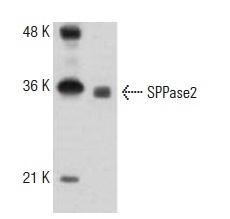
Western blot analysis of SPPase2 expression in Hep G2 whole cell lysate.Application
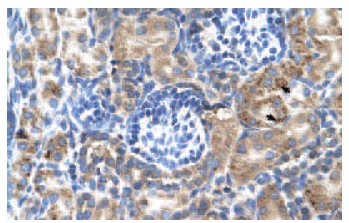
Immunoperoxidase staining of formalin-fixed, paraffin-embedded human kidney tissue showing cytoplasmic localization.| Product Name | SPPase2 Antibody (K-25) |
|---|---|
| Antibody Type | Primary Antibodies |
| Antigen Alias | recommended for detection of SPPase2 of human origin by WB, IP, IF, IHC(P) and ELISA |
| Modification Notes | Sphingosine-1-phosphate (S1P) is a lipid that functions in a variety of intracellular and extracellular biological events. The intracellular activity of S1P is regulated by its state of phosphorylation and is therefore controlled by SPP kinases (SphKs) and S1P phosphatases (SPPases). The mammalian SPPases belong to the type 2 lipid phosphate phosphatase family of N-ethylmaleimide insensitive, magnesium-independent, multi-pass membrane proteins. Characteristic of their family, SPPases contain three conserved motifs that comprise the active site of the enzyme: the SXH motif, the KXXXXXXRP motif and the SRXXXXXHXXXD motif. SPPase2, also known as SGPP2 or SPP2, localizes to the membrane of the endoplasmic reticulum (ER) and is predominantly expressed in kidney and heart with lower levels found in colon, lung, brain and small intestine. SPPase2 specifically dephosphorylates S1P, dihydro-S1P and phyto-S1P. The overexpression of SPPases can lead to an elevation in the levels of ceramide and can induce apoptosis. |
| Clonality | Polyclonal |
|---|---|
| Isotype | IgG |
| Host Species | Rabbit |
| Tested Applications | WBIPIFIHCELISA |
| WB:1:500~1:2000 IP:1:100~1:500 IF:1:200~1:500 IHC:1:50~1:200 Notes:Optimal dilutions/concentrations should be determined by the researcher. |
|
| Species Reactivity | HumanMouseRat |
| Concentration | 1mg/ml |
| Purification | Affinity purified |
| Alternative Names | recommended for detection of SPPase2 of human origin by WB IP IF IHC(P) and ELISA |
|---|---|
| Tissue Specificity | recommended for detection of SPPase2 of human origin by WB, IP, IF, IHC(P) and ELISA |
| Entrez Gene | 130367 |
|---|
Application
Western blot analysis of SPPase2 expression in Hep G2 whole cell lysate.
Application
Immunoperoxidase staining of formalin-fixed, paraffin-embedded human kidney tissue showing cytoplasmic localization.| Application Notes | WB:1:500~1:2000 IP:1:100~1:500 IF:1:200~1:500 IHC:1:50~1:200 Notes:Optimal dilutions/concentrations should be determined by the researcher. |
|---|
| Form | Liquid |
|---|---|
| Storage Instructions | For short-term storage, store at 4° C. For long-term storage, aliquot and store at -20ºC or below. Avoid multiple freeze-thaw cycles. |
| Storage Buffer | phosphate buffered saline , pH 7.4, 150mM NaCl, 0.02% sodium azide and 50% glycerol. |


