Application
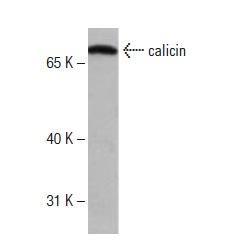
Western blot analysis of calicin expression in human fetal liver tissue extract.| Product Name | calicin Antibody (V-24) |
|---|---|
| Antibody Type | Primary Antibodies |
| Antigen Alias | recommended for detection of calicin of mouse, rat and human origin by WB, IP and ELISA |
| Modification Notes | Calicin (CCIN) is a 588 amino acid testis specific protein of the sperm head cytoskeleton. Found in the sperm head perinuclear theca, calicin localizes to the postacrosomal calyx and colocalizes with actin in the acrosomal region of round spermatids. Calicin’s ability to form tetramers and higher polymers contributes to the rigid structure of the calyx. Calicin may function as a morphogenetic cytoskeletal element during spermiogenic differentiation, and the absence or deformation of calicin may contribute to sperm malformations such as teratozoospermia. Containing one BACK (BTB/Kelch associated) domain, a BTB (POZ) domain and six Kelch repeats, calicin is encoded by a gene located on human chromosome 9, which houses over 900 genes and comprises nearly 4% of the human genome. Hereditary hemorrhagic telangiectasia, which is characterized by harmful vascular defects, and Familial dysautonomia, are both associated with chromosome 9. |
| Clonality | Polyclonal |
|---|---|
| Isotype | IgG |
| Host Species | Rabbit |
| Tested Applications | WBIPELISA |
| WB:1:500~1:2000 IP:1:100~1:500 Notes:Optimal dilutions/concentrations should be determined by the researcher. |
|
| Species Reactivity | HumanMouseRat |
| Concentration | 1mg/ml |
| Purification | Affinity purified |
| Alternative Names | recommended for detection of calicin of mouse rat and human origin by WB IP and ELISA |
|---|---|
| Tissue Specificity | recommended for detection of calicin of mouse, rat and human origin by WB, IP and ELISA |
| Entrez Gene | 881 |
|---|
Application
Western blot analysis of calicin expression in human fetal liver tissue extract.| Application Notes | WB:1:500~1:2000 IP:1:100~1:500 Notes:Optimal dilutions/concentrations should be determined by the researcher. |
|---|
| Form | Liquid |
|---|---|
| Storage Instructions | For short-term storage, store at 4° C. For long-term storage, aliquot and store at -20ºC or below. Avoid multiple freeze-thaw cycles. |
| Storage Buffer | phosphate buffered saline , pH 7.4, 150mM NaCl, 0.02% sodium azide and 50% glycerol. |


