Application
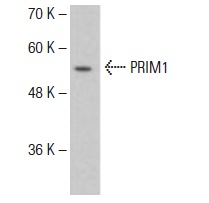
Western blot analysis of PRIM1 expression in K-562 whole cell lysate.| Product Name | PRIM1 Antibody (K-25) |
|---|---|
| Antibody Type | Primary Antibodies |
| Antigen Alias | recommended for detection of PRIM1 of mouse and human origin by WB, IP and ELISA |
| Modification Notes | In eukaryotic cells, the replication of DNA is carried out by a variety of proteins and requires a complex chromosomal replication structure, of which POLA2 (DNA polymerase alpha) and DNA primases (PRIMs) are key components. PRIM1 (DNA primase small subunit), also known as p49, is a 420 amino acidprotein that exists as a heterodimer with PRIM2A, another DNA primase. Together, PRIM1 and PRIM2A function to synthesize small RNA primers that are required for the proper activity of Okazaki fragments during replication of the DNA lagging strand. Interestingly, the gene encoding PRIM1 is coamplified with other core 12q13 amplicon genes in human osteosarcoma. In the retina of zebrafish, mutations in PRIM1 were observed to not affect cell proliferation, though neuronal apoptosis was induced. It is likely that such mutations in PRIM1 leads to activation of the ATM-Chk2-p53 apoptotic pathway. |
| Clonality | Polyclonal |
|---|---|
| Isotype | IgG |
| Host Species | Rabbit |
| Tested Applications | WBIPELISA |
| WB:1:500~1:2000 IP:1:100~1:500 Notes:Optimal dilutions/concentrations should be determined by the researcher. |
|
| Species Reactivity | HumanMouseRat |
| Concentration | 1mg/ml |
| Purification | Affinity purified |
| Alternative Names | recommended for detection of PRIM1 of mouse and human origin by WB IP and ELISA |
|---|---|
| Tissue Specificity | recommended for detection of PRIM1 of mouse and human origin by WB, IP and ELISA |
| Entrez Gene | 5557 |
|---|
Application
Western blot analysis of PRIM1 expression in K-562 whole cell lysate.| Application Notes | WB:1:500~1:2000 IP:1:100~1:500 Notes:Optimal dilutions/concentrations should be determined by the researcher. |
|---|
| Form | Liquid |
|---|---|
| Storage Instructions | For short-term storage, store at 4° C. For long-term storage, aliquot and store at -20ºC or below. Avoid multiple freeze-thaw cycles. |
| Storage Buffer | phosphate buffered saline , pH 7.4, 150mM NaCl, 0.02% sodium azide and 50% glycerol. |


