Application
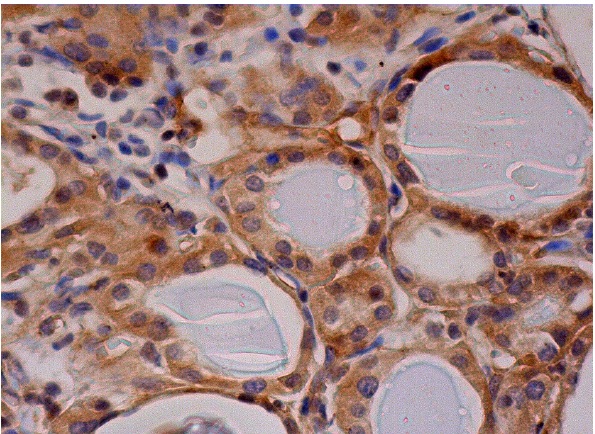
Immunoperoxidase staining of formalin fixed, paraffin-embedded human thyroid gland tissue showing cytoplasmic staining of glandular cells.Application
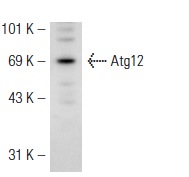
Western blot analysis of Atg12 expression in Hep G2 whole cell lysate.| Product Name | Atg12 Antibody (FL-140) |
|---|---|
| Antibody Type | Primary Antibodies |
| Antigen Alias | epitope corresponding to amino acids 1-140 representing full length Atg12 of human origin |
| Modification Notes | Atg12 (autophagy-related protein 12), also known as APG12, APG12L, FBR93 or HAPG12, is a 140 amino acid protein that is ubiquitously expressed and belongs to the Atg12 family of proteins. Atg12 is a homolog of the yeast protein Apg12 that participates in autophagy. Autophagy is a membrane trafficking mechanism that delivers cytoplasmic cargo to the vacuole/lysosome for degradation and recycling. In yeast, autophagy requires a protein conjugation system consisting of Apg12 covalently bound at the carboxy terminal glycine to lysine 149 of Apg5. Similarly in humans, Atg12 is essential for autophagy and localizes to the cytoplasm where it is covalently bound to APG5, a conjugation reaction that requires APG7, Atg10 and ATP. The Atg12-APG5 conjugate functions as an important regulator of the autophagic process and is required for the change in membrane morphology and development of autophagosomes. Due to alternative splicing events, two Atg12 isoforms exist. |
| Clonality | Polyclonal |
|---|---|
| Isotype | IgG |
| Host Species | Rabbit |
| Tested Applications | WBIPIFELISA |
| recommended for detection of Atg12 of mouse, rat and human origin by WB, IP, IF and ELISA also reactive with additional species, including equine, canine, bovine and porcine: |
|
| Species Reactivity | HumanMouseRat |
| Concentration | 1mg/ml |
| Purification | Affinity purified |
| Alternative Names | epitope corresponding to amino acids 1-140 representing full length Atg12 of human origin |
|---|---|
| Tissue Specificity | epitope corresponding to amino acids 1-140 representing full length Atg12 of human origin |
| Entrez Gene | 9140 |
|---|
Application
Immunoperoxidase staining of formalin fixed, paraffin-embedded human thyroid gland tissue showing cytoplasmic staining of glandular cells.
Application
Western blot analysis of Atg12 expression in Hep G2 whole cell lysate.| Application Notes | recommended for detection of Atg12 of mouse, rat and human origin by WB, IP, IF and ELISA also reactive with additional species, including equine, canine, bovine and porcine: |
|---|
| Form | Liquid |
|---|---|
| Storage Instructions | For short-term storage, store at 4° C. For long-term storage, aliquot and store at -20ºC or below. Avoid multiple freeze-thaw cycles. |
| Storage Buffer | phosphate buffered saline , pH 7.4, 150mM NaCl, 0.02% sodium azide and 50% glycerol. |


