Application
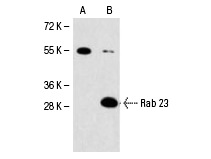
Western blot analysis of Rab 23 expression in 293 showing nontransfected (A) and transfected (B) whole cell lysates.| Product Name | Rab 23 Antibody (C-20) |
|---|---|
| Antibody Type | Primary Antibodies |
| Antigen Alias | recommended for detection of Rab 23 of human origin by WB, IP and ELISA |
| Modification Notes | The Ras-related superfamily of guanine nucleotide binding proteins includes the R-Ras, Rap, Ral/Rec and Rho/Rab subfamilies. Increasing data suggests an important role for Rab proteins in either endocytosis or in biosynthetic protein transport. The process of transporting newly synthesized proteins from the endoplasmic reticulum to various stacks of the Golgi complex and to secretory vesicles involves the movement of carrier vesicles and requires Rab protein function. Rab proteins are also an integral part of endocytic pathways. Rab 23, also known as HSPC137, is a 237 amino acid member of the Rab family of proteins and localizes to the cytoplasmic side of the cell membrane. Rab 23 is believed to play a role in intracellular protein transportation and signal transduction mediated by small GTPases. Mutations in the gene encoding Rab 23 may result in Carpenter syndrome, also known as ACPS2 (acrocephalopolysyndactyly type 2), a condition characterized by obesity, cardiac defects, polysyndactyly and craniosynostosis. |
| Clonality | Polyclonal |
|---|---|
| Isotype | IgG |
| Host Species | Rabbit |
| Tested Applications | WBIPELISA |
| WB:1:500~1:2000 IP:1:100~1:500 Notes:Optimal dilutions/concentrations should be determined by the researcher. |
|
| Species Reactivity | HumanMouseRat |
| Concentration | 1mg/ml |
| Purification | Affinity purified |
| Alternative Names | recommended for detection of Rab 23 of human origin by WB IP and ELISA |
|---|---|
| Tissue Specificity | recommended for detection of Rab 23 of human origin by WB, IP and ELISA |
| Entrez Gene | 51715 |
|---|
Application
Western blot analysis of Rab 23 expression in 293 showing nontransfected (A) and transfected (B) whole cell lysates.| Application Notes | WB:1:500~1:2000 IP:1:100~1:500 Notes:Optimal dilutions/concentrations should be determined by the researcher. |
|---|
| Form | Liquid |
|---|---|
| Storage Instructions | For short-term storage, store at 4° C. For long-term storage, aliquot and store at -20ºC or below. Avoid multiple freeze-thaw cycles. |
| Storage Buffer | phosphate buffered saline , pH 7.4, 150mM NaCl, 0.02% sodium azide and 50% glycerol. |


