Application
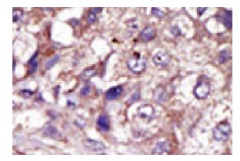
Immunoperoxidase staining of formalin fixed, paraffin-embedded human cancer tissue showing cytoplasmic staining.| Product Name | PJA1 Antibody (I-19) |
|---|---|
| Antibody Type | Primary Antibodies |
| Antigen Alias | recommended for detection of PJA1 of human origin by IF, IHC(P) and ELISA |
| Modification Notes | Ubiquitinization is an important cellular degradation process requiring sequential reactions that are mediated by three enzymes: E1, E2 and E3. PJA1, also known as Praja1 and RING finger protein 70, is a 643 amino acid E2-dependent E3-ubiquitin ligase that is abundantly expressed in regions of the brain including cerebellum, medulla, cerebral cortex, putamen, occipital pole, temporal lobe and frontal lobe. Through interaction and activation with the E2-ubiquitin ligase UBC4, PJA1 mediates substrate-specific ubiquitization via its RING finger domain. The gene encoding PJA1 may be a candidate gene for X-linked mental retardations (MRXs), such as craniofrontonasal syndrome, due to its location on the X chromosome that is frequently found mutated in MRX patients. Overexpression of PJA1 in gastrointestinal cancers suggests that it may be responsible for the degradation of spectrin ∫ II, a protein that exhibits anti-oncogenic activity. There are two named isoforms of PJA1 that exist as a result of alternative splicing events. |
| Clonality | Polyclonal |
|---|---|
| Isotype | IgG |
| Host Species | Rabbit |
| Tested Applications | IFIHCELISA |
| IF:1:200~1:500 IHC:1:50~1:200 Notes:Optimal dilutions/concentrations should be determined by the researcher. |
|
| Species Reactivity | HumanMouseRat |
| Concentration | 1mg/ml |
| Purification | Affinity purified |
| Alternative Names | recommended for detection of PJA1 of human origin by IF IHC(P) and ELISA |
|---|---|
| Tissue Specificity | recommended for detection of PJA1 of human origin by IF, IHC(P) and ELISA |
| Entrez Gene | 64219 |
|---|
Application
Immunoperoxidase staining of formalin fixed, paraffin-embedded human cancer tissue showing cytoplasmic staining.| Application Notes | IF:1:200~1:500 IHC:1:50~1:200 Notes:Optimal dilutions/concentrations should be determined by the researcher. |
|---|
| Form | Liquid |
|---|---|
| Storage Instructions | For short-term storage, store at 4° C. For long-term storage, aliquot and store at -20ºC or below. Avoid multiple freeze-thaw cycles. |
| Storage Buffer | phosphate buffered saline , pH 7.4, 150mM NaCl, 0.02% sodium azide and 50% glycerol. |


