Application
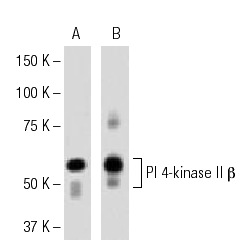
Western blot analysis of PI 4-kinase II b expression in mouse brain (A) and Saos-2 (B) whole cell lysates.Application
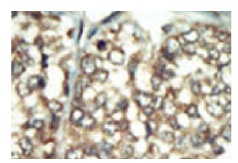
Immunoperoxidase staining of formalin fixed, paraffin-embedded human cancer tissue showing cytoplasmic staining.| Product Name | PI 4-kinase II β Antibody (C-24) |
|---|---|
| Antibody Type | Primary Antibodies |
| Antigen Alias | recommended for detection of PI 4-kinase II β of mouse and human origin by WB, IP, IF, IHC(P) and ELISA |
| Modification Notes | Phosphatidylinositol (PI) kinases participate in the first step in activating important cellular effectors, such as PIP2 (phosphatidylinositol bisphosphate) and PTEN. Unlike other PI-kinases, PI 4-kinase family members only phosphorylate phosphatidylinositols, are potently inhibited by adenosine and lack a transmembrane domain. Total PI 4-kinase activity is dependent upon PI 4-kinase ∫, PI 4-kinase å, PI 4-kinase II å and PI 4-kinase II ∫ activities. PI 4-kinase II ∫ (Phosphatidylinositol 4-kinase type II-beta) is a 481 amino acid protein that is recruited to the membrane from the cytosol to stimulate synthesis of PIP2 and, in this way, PI 4-kinase II ∫ contributes to the production of IP3. PI 4-kinase II ∫ may also be involved in the regulation of vesicular trafficking due to its associations with the endoplasmic reticulum and the golgi apparatus. T-cells specific for PI 4-kinase II ∫ lyse normal and malignant hematopoietic cells, suggesting that PI 4-kinase II ∫ may play a role in antitumor immunity. |
| Clonality | Polyclonal |
|---|---|
| Isotype | IgG |
| Host Species | Rabbit |
| Tested Applications | WBIPIFIHCELISA |
| WB:1:500~1:2000 IP:1:100~1:500 IF:1:200~1:500 IHC:1:50~1:200 Notes:Optimal dilutions/concentrations should be determined by the researcher. |
|
| Species Reactivity | HumanMouseRat |
| Concentration | 1mg/ml |
| Purification | Affinity purified |
| Alternative Names | recommended for detection of PI 4-kinase II &beta of mouse and human origin by WB IP IF IHC(P) and ELISA |
|---|---|
| Tissue Specificity | recommended for detection of PI 4-kinase II β of mouse and human origin by WB, IP, IF, IHC(P) and ELISA |
| Entrez Gene | 55300 |
|---|
Application
Western blot analysis of PI 4-kinase II b expression in mouse brain (A) and Saos-2 (B) whole cell lysates.
Application
Immunoperoxidase staining of formalin fixed, paraffin-embedded human cancer tissue showing cytoplasmic staining.| Application Notes | WB:1:500~1:2000 IP:1:100~1:500 IF:1:200~1:500 IHC:1:50~1:200 Notes:Optimal dilutions/concentrations should be determined by the researcher. |
|---|
| Form | Liquid |
|---|---|
| Storage Instructions | For short-term storage, store at 4° C. For long-term storage, aliquot and store at -20ºC or below. Avoid multiple freeze-thaw cycles. |
| Storage Buffer | phosphate buffered saline , pH 7.4, 150mM NaCl, 0.02% sodium azide and 50% glycerol. |


