Application
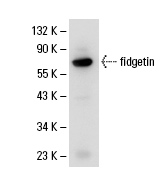
Western blot analysis of fidgetin expression in mouse heart tissue extract.| Product Name | fidgetin Antibody (H-146) |
|---|---|
| Antibody Type | Primary Antibodies |
| Antigen Alias | epitope corresponding to amino acids 75-220 mapping near the N-terminus of fidgetin of human origin |
| Modification Notes | The mouse Fign gene encodes a 759 amino acid protein that is a member of the AAA (ATPases associated with diverse cellular activities) family of ATPases. Fidgetin is a member of the 'meiotic' or subfamily-7 group of ATPases associated with diverse cellular activities (AAA proteins). Fidgetin can interact with itself and this interaction can be abolished by truncating either the N- or C-terminus of the protein. AAA proteins are molecular chaperones that facilitate membrane fusion, proteolysis, peroxisome biogenesis, endosome sorting and meiotic spindle formation. The mouse mutation fidget arose spontaneously in a heterogeneous albino stock. This mutant mouse is characterized by a side-to-side head-shaking and circling behavior due to reduced or absent semicircular canals. Fidget mice have small eyes that are associated with cell-cycle delay and insufficient growth of the retinal neural epithelium, and lower penetrance skeletal abnormalities including pelvic girdle dysgenesis, skull bone fusions and polydactyly. |
| Clonality | Polyclonal |
|---|---|
| Isotype | IgG |
| Host Species | Rabbit |
| Tested Applications | WBIPIFELISA |
| recommended for detection of fidgetin of mouse, rat and human origin by WB, IP, IF and ELISA also reactive with additional species, including equine, canine, bovine, porcine and avian: |
|
| Species Reactivity | HumanMouseRat |
| Concentration | 1mg/ml |
| Purification | Affinity purified |
| Alternative Names | epitope corresponding to amino acids 75-220 mapping near the N-terminus of fidgetin of human origin |
|---|---|
| Tissue Specificity | epitope corresponding to amino acids 75-220 mapping near the N-terminus of fidgetin of human origin |
| Entrez Gene | 55137 |
|---|
Application
Western blot analysis of fidgetin expression in mouse heart tissue extract.| Application Notes | recommended for detection of fidgetin of mouse, rat and human origin by WB, IP, IF and ELISA also reactive with additional species, including equine, canine, bovine, porcine and avian: |
|---|
| Form | Liquid |
|---|---|
| Storage Instructions | For short-term storage, store at 4° C. For long-term storage, aliquot and store at -20ºC or below. Avoid multiple freeze-thaw cycles. |
| Storage Buffer | phosphate buffered saline , pH 7.4, 150mM NaCl, 0.02% sodium azide and 50% glycerol. |


