Application
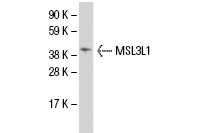
Western blot analysis of MSL3L1 expression in fetal spleen tissue extract.| Product Name | MSL3L1 Antibody (G-19) |
|---|---|
| Antibody Type | Primary Antibodies |
| Antigen Alias | raised against MSL3L1 of human origin |
| Modification Notes | Drosophila melanogaster is a proven and effective model for studying developmental and cellular processes common to higher eukaryotes. Approximately 13,600 genes have been elucidated from more than 120 megabases of euchromatin, and they are organized among the chromosomes 2, 3, 4, X and Y, with the Y chromosome being predominately heterochromatic. The male-specific lethal (MSL) genes (including MSL3L1 and MSL3L2) are essential for X-chromosome dosage compensation. The human gene MSL3L1 encodes a protein with significant homology to Drosophila MSL-3 in three distinct regions, which include two putative chromo domains. The MSL3L1 gene maps to a chromosomal location implicated in several disorders, including microphthalmia with linear skin defects (MLS or MIDAS), OFD1 and SED tarda, as well as Aicardi syndrome and Goltz syndrome. |
| Clonality | Polyclonal |
|---|---|
| Isotype | IgG |
| Host Species | Rabbit |
| Tested Applications | WBIPELISA |
| recommended for detection of MSL3L1 of mouse, rat, human and canine origin by WB, IP and ELISA: |
|
| Species Reactivity | HumanMouseRat |
| Concentration | 1mg/ml |
| Purification | Affinity purified |
| Alternative Names | raised against MSL3L1 of human origin |
|---|---|
| Tissue Specificity | raised against MSL3L1 of human origin |
| Entrez Gene | 10943 |
|---|
Application
Western blot analysis of MSL3L1 expression in fetal spleen tissue extract.| Application Notes | recommended for detection of MSL3L1 of mouse, rat, human and canine origin by WB, IP and ELISA: |
|---|
| Form | Liquid |
|---|---|
| Storage Instructions | For short-term storage, store at 4° C. For long-term storage, aliquot and store at -20ºC or below. Avoid multiple freeze-thaw cycles. |
| Storage Buffer | phosphate buffered saline , pH 7.4, 150mM NaCl, 0.02% sodium azide and 50% glycerol. |


