Application
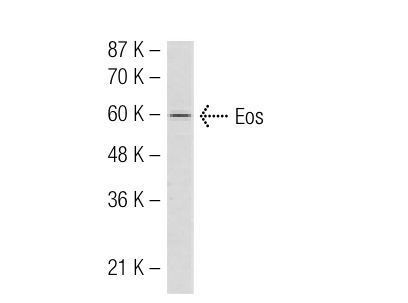
Western blot analysis of Eos expression in Hep G2 whole cell lysate.| Product Name | Eos Antibody (D-17) |
|---|---|
| Antibody Type | Primary Antibodies |
| Antigen Alias | raised against Eos of human origin |
| Modification Notes | Ikaros family members, including Ikaros and Helios, are nuclear factors that colocalize with DNA replication machinery components in higher-order chromatin structures and respond to signaling events, such as T-cell activation. Helios and Ikaros bind to similar DNA sequences and they function as hemopoietic-specific transcription factors. Members of the Ikaros family contain zinc-finger domains that are involved in DNA-binding and in the formation of homodimers and heterodimers between Ikaros family members. Eos, also known as zinc finger protein Ikaros 4, is a 585 amino acid transcriptional repressor. Localized to the nucleus, Eos may play a role in the development of the central and peripheral nervous systems. Eos self-associates, forms heterodimers with Ikaros family members and interacts with CtBP2, PU.1 and MITF to repress transcription of cathepsin K and TRAP promoters. Eos is expressed at low levels in kidney, thymus, liver and heart, and at high levels in skeletal muscle. |
| Clonality | Polyclonal |
|---|---|
| Isotype | IgG |
| Host Species | Rabbit |
| Tested Applications | WBIPELISA |
| recommended for detection of Eos of human and canine origin by WB, IP and ELISA: |
|
| Species Reactivity | HumanMouseRat |
| Concentration | 1mg/ml |
| Purification | Affinity purified |
| Alternative Names | raised against Eos of human origin |
|---|---|
| Tissue Specificity | raised against Eos of human origin |
| Entrez Gene | 64375 |
|---|
Application
Western blot analysis of Eos expression in Hep G2 whole cell lysate.| Application Notes | recommended for detection of Eos of human and canine origin by WB, IP and ELISA: |
|---|
| Form | Liquid |
|---|---|
| Storage Instructions | For short-term storage, store at 4° C. For long-term storage, aliquot and store at -20ºC or below. Avoid multiple freeze-thaw cycles. |
| Storage Buffer | phosphate buffered saline , pH 7.4, 150mM NaCl, 0.02% sodium azide and 50% glycerol. |


