Application
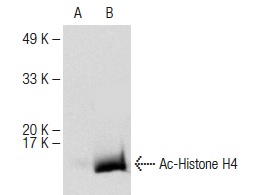
Antibody tested is Ac-Histone H4 (Lys 8): (A,B). Note acetylation of Ac-Histone H4 in lane B.| Product Name | Ac-Histone H4 Antibody (Lys 8) |
|---|---|
| Antibody Type | Primary Antibodies |
| Antigen Alias | recommended for detection of Lysine 8 acetylated Histone H4 of broad species origin by WB and IF |
| Modification Notes | In eukaryotes, DNA is wrapped around histone octamers to form the basic unit of chromatin structure. The octamer is composed of histones H2A, H2B, H3 and H4, and it associates with approximately 200 base pairs of DNA to form the nucleosome. The association of DNA with histones results in dense packing of chromatin, which restricts proteins involved in gene transcription from binding to DNA. p300 preferentially acetylates Histone H3 at lysines 14 and 18 and Histone H4 at lysines 5 and 8. PCAF in its native form, primarily acetylates Histone H3 at lysine 14 to a monoacetylated form, and less efficiently acetylates Histone H4 at lysine 8. Histone H4 may also be acetylated at lysines 12 and 16, and the involvement of acetylated H4 with Histones H2A, H2B and H3 suggests that acetylated histones may be involved in dynamic chromatin remodeling. |
| Clonality | Polyclonal |
|---|---|
| Isotype | IgG |
| Host Species | Rabbit |
| Tested Applications | WBIF |
| WB:1:500~1:2000 IF:1:200~1:500 Notes:Optimal dilutions/concentrations should be determined by the researcher. |
|
| Species Reactivity | HumanMouseRat |
| Concentration | 1mg/ml |
| Purification | Affinity purified |
| Alternative Names | recommended for detection of Lysine 8 acetylated Histone H4 of broad species origin by WB and IF |
|---|---|
| Tissue Specificity | recommended for detection of Lysine 8 acetylated Histone H4 of broad species origin by WB and IF |
Application
Antibody tested is Ac-Histone H4 (Lys 8): (A,B). Note acetylation of Ac-Histone H4 in lane B.| Application Notes | WB:1:500~1:2000 IF:1:200~1:500 Notes:Optimal dilutions/concentrations should be determined by the researcher. |
|---|
| Form | Liquid |
|---|---|
| Storage Instructions | For short-term storage, store at 4° C. For long-term storage, aliquot and store at -20ºC or below. Avoid multiple freeze-thaw cycles. |
| Storage Buffer | phosphate buffered saline , pH 7.4, 150mM NaCl, 0.02% sodium azide and 50% glycerol. |


