Application
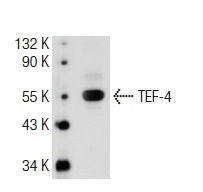
Western blot analysis of TEF-4 expression in IMR-32 whole cell lysate.Application
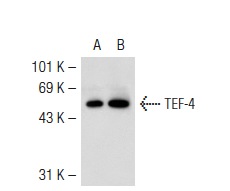
Western blot analysis of TEF-4 expression in non-transfected: (A) and human TEF-4 transfected: (B) 293T whole cell lysates.| Product Name | TEF-4 Antibody (H-50) |
|---|---|
| Antibody Type | Primary Antibodies |
| Antigen Alias | epitope corresponding to amino acids 181-230 mapping within an internal region of TEF-4 of human origin |
| Modification Notes | The transcriptional enhancer factor (TEF)/TEAD family includes TEF-1, TEF-3, TEF-4 and TEF-5. These proteins share a highly conserved 68-amino acid TEA/ATTS DNA-binding domain, which binds to SV40 GT-IIC (GGAATG), SphI (AGTATG), SphII (AGCATG), and muscle-specific M-CAT (GGTATG) enhansons. TEFs are differentially expressed in human cultured cell lines and mouse embryonic and extra-embryonic tissues. Specifically, TEF-4 is strongly coexpressed with TEF-1 in mouse mitotic neuroblasts and is also detected in the gut and the nephrogenic region of the kidney. TEF-4 associates with the powerful transcriptional coactivator YAP65 to mediate mitogenic signals. In addition, TEF-4 promotes the activation of the CTP:phosphocholine cytidylyltransferase (CCT) alpha protein, which is the rate-limiting enzyme of phosphatidylcholine biosynthesis, by enhancing the transcriptional activity of Ets-1. |
| Clonality | Polyclonal |
|---|---|
| Isotype | IgG |
| Host Species | Rabbit |
| Tested Applications | WBIPIFELISAGSChIP |
| recommended for detection of TEF-4 of mouse, rat and human origin by WB, IP, IF and ELISA: |
|
| Species Reactivity | HumanMouseRat |
| Concentration | 1mg/ml |
| Purification | Affinity purified |
| Alternative Names | epitope corresponding to amino acids 181-230 mapping within an internal region of TEF-4 of human origin |
|---|---|
| Tissue Specificity | epitope corresponding to amino acids 181-230 mapping within an internal region of TEF-4 of human origin |
| Entrez Gene | 8463 |
|---|
Application
Western blot analysis of TEF-4 expression in IMR-32 whole cell lysate.
Application
Western blot analysis of TEF-4 expression in non-transfected: (A) and human TEF-4 transfected: (B) 293T whole cell lysates.| Application Notes | recommended for detection of TEF-4 of mouse, rat and human origin by WB, IP, IF and ELISA: |
|---|
| Form | Liquid |
|---|---|
| Storage Instructions | For short-term storage, store at 4° C. For long-term storage, aliquot and store at -20ºC or below. Avoid multiple freeze-thaw cycles. |
| Storage Buffer | phosphate buffered saline , pH 7.4, 150mM NaCl, 0.02% sodium azide and 50% glycerol. |


