Application
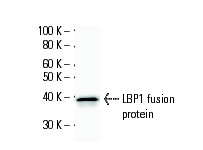
Western blot analysis of mouse recombinant CA XV fusion protein.| Product Name | CA XV Antibody (M-91) |
|---|---|
| Antibody Type | Primary Antibodies |
| Antigen Alias | epitope corresponding to amino acids 1-91 mapping at the N-terminus of CA XV of mouse origin |
| Modification Notes | Carbonic anhydrases (CAs) are members of a large family of zinc metalloenzymes responsible for catalyzing the reversible hydration of carbon dioxide. CAs show extensive diversity in their distribution and subcellular localization. They are involved in a variety of biological processes, including calcification, bone resorption, respiration, acid-base balance and the formation of aqueous humor, saliva, gastric juice and cerebrospinal fluid. CA XV, also referred to as Carbonate dehydratase XV or Car15, is a glycosylated glycosylphosphatidylinositol-anchored membrane protein expressed ubiquitously at low levels. CA XV is predomimantly expressed in kidney, brain and testis. In humans and chimpanzees, it is a non-processed pseudogene. In mouse, CA XV exhibits highest homology with family member CA IV. CA XV contains three glycosylation sites at asparagine residues 189, 201 and 210. |
| Clonality | Polyclonal |
|---|---|
| Isotype | IgG |
| Host Species | Rabbit |
| Tested Applications | WBIPIFELISA |
| recommended for detection of CA XV of mouse and rat origin by WB, IP, IF and ELISA: |
|
| Species Reactivity | HumanMouseRat |
| Concentration | 1mg/ml |
| Purification | Affinity purified |
| Alternative Names | epitope corresponding to amino acids 1-91 mapping at the N-terminus of CA XV of mouse origin |
|---|---|
| Tissue Specificity | epitope corresponding to amino acids 1-91 mapping at the N-terminus of CA XV of mouse origin |
| Entrez Gene | 80733 |
|---|
Application
Western blot analysis of mouse recombinant CA XV fusion protein.| Application Notes | recommended for detection of CA XV of mouse and rat origin by WB, IP, IF and ELISA: |
|---|
| Form | Liquid |
|---|---|
| Storage Instructions | For short-term storage, store at 4° C. For long-term storage, aliquot and store at -20ºC or below. Avoid multiple freeze-thaw cycles. |
| Storage Buffer | phosphate buffered saline , pH 7.4, 150mM NaCl, 0.02% sodium azide and 50% glycerol. |


