Application
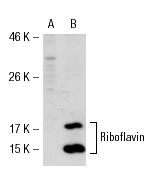
Western blot analysis of Riboflavin kinase expression in non-transfected: (A) and mouse Riboflavin kinase transfected: (B) 293T whole cell lysates.| Product Name | Riboflavin kinase Antibody (H-86) |
|---|---|
| Antibody Type | Primary Antibodies |
| Antigen Alias | epitope corresponding to amino acids 1-86 mapping at the N-terminus of Riboflavin kinase of human origin |
| Modification Notes | Riboflavin kinase, also known as RFK or RIFK, is a cytoplasmic protein that catalyzes the first step in flavocoenzyme biosynthesis, namely the ATP-dependent phosphorylation of riboflavin to form flavin-mononucleotide (FMN). Expressed in the brain, placenta and bladder, Riboflavin kinase is a 162 amino acid protein for which zinc and magnesium are cofactors. Riboflavin kinase has three distinct conformational states that are referred to as the binary MgADP complex, the ternary product complex and the apo form, all of which contribute to the unique substrate binding and catalytic activity of the enzyme. Human Riboflavin kinase shares 44% homology with its yeast counterpart, suggesting that the three flexible regions surrounding the active site (termed Flap I, Flap II and Helix B) are similar in both species. |
| Clonality | Polyclonal |
|---|---|
| Isotype | IgG |
| Host Species | Rabbit |
| Tested Applications | WBIPIFELISA |
| recommended for detection of Riboflavin kinase of mouse, rat and human origin by WB, IP, IF and ELISA also reactive with additional species, including canine and bovine: |
|
| Species Reactivity | HumanMouseRat |
| Concentration | 1mg/ml |
| Purification | Affinity purified |
| Alternative Names | epitope corresponding to amino acids 1-86 mapping at the N-terminus of Riboflavin kinase of human origin |
|---|---|
| Tissue Specificity | epitope corresponding to amino acids 1-86 mapping at the N-terminus of Riboflavin kinase of human origin |
| Entrez Gene | 55312 |
|---|
Application
Western blot analysis of Riboflavin kinase expression in non-transfected: (A) and mouse Riboflavin kinase transfected: (B) 293T whole cell lysates.| Application Notes | recommended for detection of Riboflavin kinase of mouse, rat and human origin by WB, IP, IF and ELISA also reactive with additional species, including canine and bovine: |
|---|
| Form | Liquid |
|---|---|
| Storage Instructions | For short-term storage, store at 4° C. For long-term storage, aliquot and store at -20ºC or below. Avoid multiple freeze-thaw cycles. |
| Storage Buffer | phosphate buffered saline , pH 7.4, 150mM NaCl, 0.02% sodium azide and 50% glycerol. |


