Application
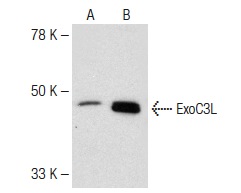
Western blot analysis of ExoC3L expression in non-transfected: (A) and human ExoC3L transfected: (B) 293T whole cell lysates.| Product Name | ExoC3L Antibody (G-13) |
|---|---|
| Antibody Type | Primary Antibodies |
| Antigen Alias | epitope mapping within an internal region of ExoC3L of human origin |
| Modification Notes | ExoC3L (exocyst complex component 3-like protein), also known as protein jiangli, is a 746 amino acid protein that belongs to the SEC6 family. Localizing to the cytoplasmic and secretory vesicle, ExoC3L colocalizes with insulin granules and interacts with ExoC2, ExoC4 and ExoC5. Acting as part of the exocyst, ExoC3L may function in the regulation of insulin granule exocytosis and is expressed in insulin-secreting MIN6 cells, as well as various tissues including brain and pancreatic islets. The gene encoding ExoC3L maps to human chromosome 16, which encodes over 900 genes and comprises nearly 3% of the human genome. The GAN gene is located on chromosome 16 and, with mutation, may lead to giant axonal neuropathy, a nervous system disorder characterized by increasing malfunction with growth. The rare disorder Rubinstein-Taybi syndrome is also associated with chromosome 16, as is Crohn's disease, which is a gastrointestinal inflammatory condition. |
| Clonality | Polyclonal |
|---|---|
| Isotype | IgG |
| Host Species | Rabbit |
| Tested Applications | WBIPIFELISA |
| recommended for detection of ExoC3L of mouse, rat and human origin by WB, IP, IF and ELISA non cross-reactive with ExoC3L2 also reactive with additional species, including canine, bovine and porcine: |
|
| Species Reactivity | HumanMouseRat |
| Concentration | 1mg/ml |
| Purification | Affinity purified |
| Alternative Names | epitope mapping within an internal region of ExoC3L of human origin |
|---|---|
| Tissue Specificity | epitope mapping within an internal region of ExoC3L of human origin |
| Entrez Gene | 283849 |
|---|
Application
Western blot analysis of ExoC3L expression in non-transfected: (A) and human ExoC3L transfected: (B) 293T whole cell lysates.| Application Notes | recommended for detection of ExoC3L of mouse, rat and human origin by WB, IP, IF and ELISA non cross-reactive with ExoC3L2 also reactive with additional species, including canine, bovine and porcine: |
|---|
| Form | Liquid |
|---|---|
| Storage Instructions | For short-term storage, store at 4° C. For long-term storage, aliquot and store at -20ºC or below. Avoid multiple freeze-thaw cycles. |
| Storage Buffer | phosphate buffered saline , pH 7.4, 150mM NaCl, 0.02% sodium azide and 50% glycerol. |


