Application
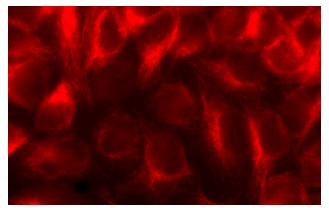
Immunofluorescence staining of methanol-fixed HeLa cells showing cytoplasmic localization.Application
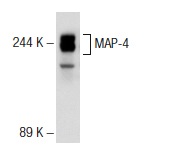
Western blot analysis of MAP-4 expression in 293T whole cell lysate.| Product Name | MAP-4 Antibody (H-300) |
|---|---|
| Antibody Type | Primary Antibodies |
| Antigen Alias | epitope corresponding to amino acids 1-300 mapping at the N-terminus of MAP-4 of human origin |
| Modification Notes | Microtubules, the primary component of the cytoskeletal network, interact with proteins called microtubule-associated proteins (MAPs). The microtubule-associated proteins can be divided into two groups, structural and dynamic. The MAP proteins function to stimulate tubulin assembly, enhance microtubule stability, influence the spatial distribution of microtubules within cells and utilize microtubule polarity to translocate cellular components. MAP-4 is a non-neuronal microtubule-associated protein that contains three, 18 amino acid repeats that are homologous to the repeats found in several other MAP proteins. Studies have shown that MAP-4 is involved with interphase microtubule, mitotic spindle fibers and mitotic movements. The protein, which promotes microtubule assembly, is primarily expressed in kidney, lung, liver, testis and spleen. |
| Clonality | Polyclonal |
|---|---|
| Isotype | IgG |
| Host Species | Rabbit |
| Tested Applications | WBIPIFELISA |
| recommended for detection of MAP-4 isoform 1 and 2 of human origin by WB, IP, IF and ELISA: |
|
| Species Reactivity | HumanMouseRat |
| Concentration | 1mg/ml |
| Purification | Affinity purified |
| Alternative Names | epitope corresponding to amino acids 1-300 mapping at the N-terminus of MAP-4 of human origin |
|---|---|
| Tissue Specificity | epitope corresponding to amino acids 1-300 mapping at the N-terminus of MAP-4 of human origin |
| Entrez Gene | 4134 |
|---|
Application
Immunofluorescence staining of methanol-fixed HeLa cells showing cytoplasmic localization.
Application
Western blot analysis of MAP-4 expression in 293T whole cell lysate.| Application Notes | recommended for detection of MAP-4 isoform 1 and 2 of human origin by WB, IP, IF and ELISA: |
|---|
| Form | Liquid |
|---|---|
| Storage Instructions | For short-term storage, store at 4° C. For long-term storage, aliquot and store at -20ºC or below. Avoid multiple freeze-thaw cycles. |
| Storage Buffer | phosphate buffered saline , pH 7.4, 150mM NaCl, 0.02% sodium azide and 50% glycerol. |


