Application
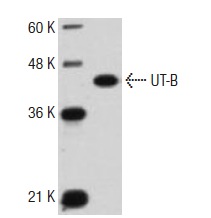
Western blot analysis of UT-B expression in Jurkat whole cell lysate.Application
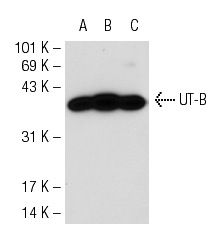
Western blot analysis of UT-B expression in non-transfected 293T: (A), mouse UT-B transfected 293T: (B) and HEL 92.1.7 (C) whole cell lysates.| Product Name | UT-B Antibody (O-24) |
|---|---|
| Antibody Type | Primary Antibodies |
| Antigen Alias | recommended for detection of UT-B of human origin by WB, IP, IF, IHC(P) and ELISA |
| Modification Notes | The Kidd antigen system (also referred to as the Jk antigen system) exists on the membrane of red blood cells (erythrocytes) and is responsible for urea transport and blood type determination. On the surface of red blood cells, Jk antigens (which exist as two alleles, designated Jk(a) and Jk(b)) are associated with a protein, known as UT-B, whose function is to mediate urea transport in kidneys and erythrocytes. UT-B, also known as SLC14A (solute carrier family 14 (urea transporter), member 1 (Kidd blood group)), Jk, UT1, UTE, HUT11 or RACH1, is a 389 amino acid multi-pass membrane protein that is exists as a low-affinity urea transporter and is responsible for determination of Jk alleles. The gene encoding UT-B maps to human chromosome 18, which houses over 300 protein-coding genes and contains nearly 76 million bases. |
| Clonality | Polyclonal |
|---|---|
| Isotype | IgG |
| Host Species | Rabbit |
| Tested Applications | WBIPIFIHCELISA |
| WB:1:500~1:2000 IP:1:100~1:500 IF:1:200~1:500 IHC:1:50~1:200 Notes:Optimal dilutions/concentrations should be determined by the researcher. |
|
| Species Reactivity | HumanMouseRat |
| Concentration | 1mg/ml |
| Purification | Affinity purified |
| Alternative Names | recommended for detection of UT-B of human origin by WB IP IF IHC(P) and ELISA |
|---|---|
| Tissue Specificity | recommended for detection of UT-B of human origin by WB, IP, IF, IHC(P) and ELISA |
| Entrez Gene | 6563 |
|---|
Application
Western blot analysis of UT-B expression in Jurkat whole cell lysate.
Application
Western blot analysis of UT-B expression in non-transfected 293T: (A), mouse UT-B transfected 293T: (B) and HEL 92.1.7 (C) whole cell lysates.| Application Notes | WB:1:500~1:2000 IP:1:100~1:500 IF:1:200~1:500 IHC:1:50~1:200 Notes:Optimal dilutions/concentrations should be determined by the researcher. |
|---|
| Form | Liquid |
|---|---|
| Storage Instructions | For short-term storage, store at 4° C. For long-term storage, aliquot and store at -20ºC or below. Avoid multiple freeze-thaw cycles. |
| Storage Buffer | phosphate buffered saline , pH 7.4, 150mM NaCl, 0.02% sodium azide and 50% glycerol. |


