Application
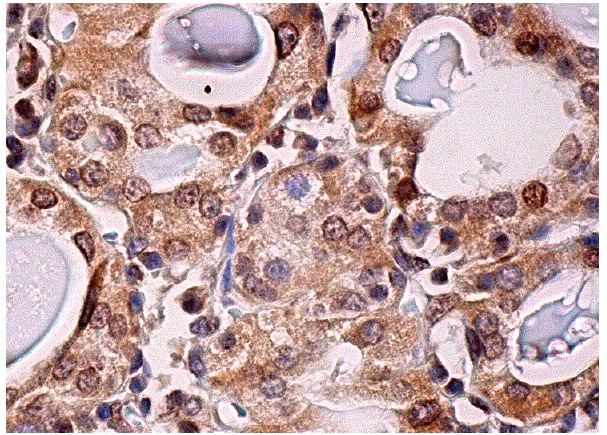
Immunoperoxidase staining of formalin fixed, paraffin-embedded human thyroid gland tissue showing nuclear and cytoplasmic staining of glandular cells.Application
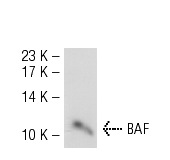
Western blot analysis of BAF expression in HeLa nuclear extract.| Product Name | BAF Antibody (FL-89) |
|---|---|
| Antibody Type | Primary Antibodies |
| Antigen Alias | epitope corresponding to amino acids 1-89 representing full length barrier-to-autointegration factor of human origin |
| Modification Notes | Barrier-to-autointegration factor (BAF) binds non-specifically to double stranded DNA, possibly to play a role in tissue- or cell type-specific gene expression by interacting with different homeodomain transcription factors. BAF compresses chromatin structure and interacts with the LEM domain of nuclear proteins to play a crucial role in membrane recruitment and chromatin decondensation during nuclear assembly. Additionally, retroviruses like HIV-1 incorporate BAF from host cells into preintegration complexes (PICs) to prevent autointegration of retroviral DNA and thereby promote integration of retroviral DNA into the host chromosome. |
| Clonality | Polyclonal |
|---|---|
| Isotype | IgG |
| Host Species | Rabbit |
| Tested Applications | WBIPIFIHCELISAGSChIP |
| recommended for detection of barrier-to-autointegration factor of mouse, rat and human origin by WB, IP, IF, IHC(P) and ELISA also reactive with additional species, including equine, canine, bovine and porcine: |
|
| Species Reactivity | HumanMouseRat |
| Concentration | 1mg/ml |
| Purification | Affinity purified |
| Alternative Names | epitope corresponding to amino acids 1-89 representing full length barrier-to-autointegration factor of human origin |
|---|---|
| Tissue Specificity | epitope corresponding to amino acids 1-89 representing full length barrier-to-autointegration factor of human origin |
| Entrez Gene | 8815 |
|---|
Application
Immunoperoxidase staining of formalin fixed, paraffin-embedded human thyroid gland tissue showing nuclear and cytoplasmic staining of glandular cells.
Application
Western blot analysis of BAF expression in HeLa nuclear extract.| Application Notes | recommended for detection of barrier-to-autointegration factor of mouse, rat and human origin by WB, IP, IF, IHC(P) and ELISA also reactive with additional species, including equine, canine, bovine and porcine: |
|---|
| Form | Liquid |
|---|---|
| Storage Instructions | For short-term storage, store at 4° C. For long-term storage, aliquot and store at -20ºC or below. Avoid multiple freeze-thaw cycles. |
| Storage Buffer | phosphate buffered saline , pH 7.4, 150mM NaCl, 0.02% sodium azide and 50% glycerol. |


