Application
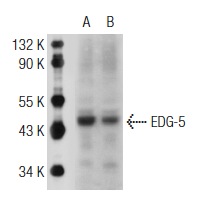
Western blot analysis of EDG-5 expression in mouse heart (A) and rat heart (B) tissue extracts.Application
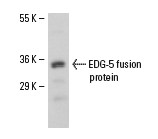
Western blot analysis of human recombinant EDG-5 fusion protein.| Product Name | EDG-5 Antibody (H-64) |
|---|---|
| Antibody Type | Primary Antibodies |
| Antigen Alias | epitope corresponding to amino acids 284-347 of EDG-5 of human origin |
| Modification Notes | The EDG (endothelial differentiation gene) family of G protein coupled receptors consists of eight family members that bind lysophospholipid (LPL) mediators, including sphingosine-1-phosphate (SPP) and lysophosphatidic acid (LPA). EDG-1, EDG-3, EDG-5 (also designated H218 and AGR16) and EDG-8 bind SPP with high affinity. EDG-6 is a low affinity receptor for SPP. LPA preferentially binds to EDG-2, EDG-4 and EDG-7. The EDG receptors couple to multiple G proteins to signal through Ras, MAP kinase, Rho, Phospholipase C or other tyrosine kinases, which lead to cell survival, growth, migration and differentiation. EDG-1 signals through Gi proteins to activate Akt and is expressed in glioma cells. EDG-2 is expressed in brain, especially in white matter tract regions, while EDG-3 is expressed in cardiovascular tissue and in cerebellum. EDG-4 is highly expressed on leukocytes and brain, and EDG-5 has wide tissue distribution, including cardiovascular tissue and brain. EDG-6, which is expressed in lymphoid and hematopoietic tissues and in lung, signals through G(i/o) proteins, which activate growth related pathways. |
| Clonality | Polyclonal |
|---|---|
| Isotype | IgG |
| Host Species | Rabbit |
| Tested Applications | WBIPIFELISA |
| recommended for detection of EDG-5 of mouse, rat and human origin by WB, IP, IF and ELISA also reactive with additional species, including bovine and porcine: |
|
| Species Reactivity | HumanMouseRat |
| Concentration | 1mg/ml |
| Purification | Affinity purified |
| Alternative Names | epitope corresponding to amino acids 284-347 of EDG-5 of human origin |
|---|---|
| Tissue Specificity | epitope corresponding to amino acids 284-347 of EDG-5 of human origin |
| Entrez Gene | 9294 |
|---|
Application
Western blot analysis of EDG-5 expression in mouse heart (A) and rat heart (B) tissue extracts.
Application
Western blot analysis of human recombinant EDG-5 fusion protein.| Application Notes | recommended for detection of EDG-5 of mouse, rat and human origin by WB, IP, IF and ELISA also reactive with additional species, including bovine and porcine: |
|---|
| Form | Liquid |
|---|---|
| Storage Instructions | For short-term storage, store at 4° C. For long-term storage, aliquot and store at -20ºC or below. Avoid multiple freeze-thaw cycles. |
| Storage Buffer | phosphate buffered saline , pH 7.4, 150mM NaCl, 0.02% sodium azide and 50% glycerol. |


