Application
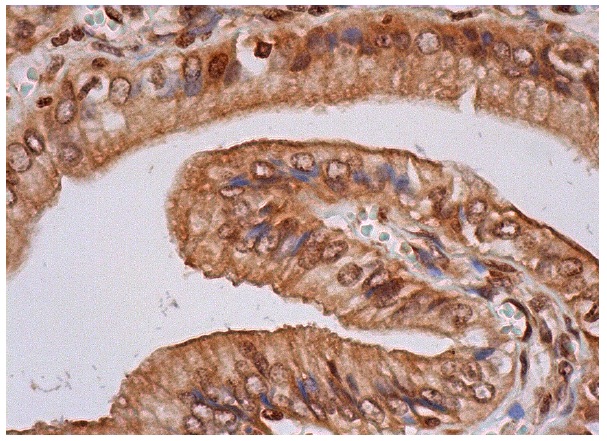
Immunoperoxidase staining of formalin fixed, paraffin-embedded human gall bladder tissue showing nuclear and cytoplasmic staining of glandular cells.Application
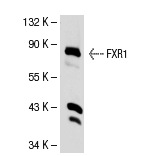
Western blot analysis of FXR1 expression in F9 whole cell lysate.| Product Name | FXR1 Antibody (H-57) |
|---|---|
| Antibody Type | Primary Antibodies |
| Antigen Alias | epitope corresponding to amino acids 552-608 mapping at the C-terminus of FXR1 of human origin |
| Modification Notes | Fragile X syndrome is the most frequent form of inherited mental retardation and is the result of transcriptional silencing of the FMR1 gene on the X chromosome. The FMR1 gene contains a distinct CpG dinucleotide repeat located in the 5' untranslated region of the gene. In fragile X syndrome this tandem repeat is substantially amplified and subjected to extensive methylation and enhanced transcriptional silencing. The FMR1 protein (or FMRP) is an RNA-binding protein that associates with polyribosomes and is a likely component of a messenger ribonuclear protein (mRNP) particle. It contains several features that are characteristics of RNA-binding proteins, including two hnRNPK homology (KH) domains and an RGG amino acid motif (RGG box). FMR1 localizes to both the nucleus and the cytoplasm and can also interact with two fragile X syndrome related factors, FXR1 and FXR2, which form heterodimers through their N-terminal coiled-coil domains. Since FMR1 contains both a nuclear localization signal and a nuclear export signal it is also implicated in the nucleocytoplasmic transport of mRNAs. |
| Clonality | Polyclonal |
|---|---|
| Isotype | IgG |
| Host Species | Rabbit |
| Tested Applications | WBIPIFIHCELISA |
| recommended for detection of FXR1 of mouse, rat and human origin by WB, IP, IF, IHC(P) and ELISA also reactive with additional species, including equine, canine, bovine and porcine: |
|
| Species Reactivity | HumanMouseRat |
| Concentration | 1mg/ml |
| Purification | Affinity purified |
| Alternative Names | epitope corresponding to amino acids 552-608 mapping at the C-terminus of FXR1 of human origin |
|---|---|
| Tissue Specificity | epitope corresponding to amino acids 552-608 mapping at the C-terminus of FXR1 of human origin |
| Entrez Gene | 8087 |
|---|
Application
Immunoperoxidase staining of formalin fixed, paraffin-embedded human gall bladder tissue showing nuclear and cytoplasmic staining of glandular cells.
Application
Western blot analysis of FXR1 expression in F9 whole cell lysate.| Application Notes | recommended for detection of FXR1 of mouse, rat and human origin by WB, IP, IF, IHC(P) and ELISA also reactive with additional species, including equine, canine, bovine and porcine: |
|---|
| Form | Liquid |
|---|---|
| Storage Instructions | For short-term storage, store at 4° C. For long-term storage, aliquot and store at -20ºC or below. Avoid multiple freeze-thaw cycles. |
| Storage Buffer | phosphate buffered saline , pH 7.4, 150mM NaCl, 0.02% sodium azide and 50% glycerol. |


