Application
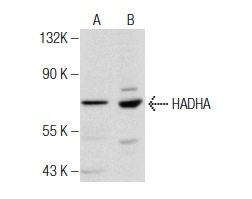
Western blot analysis of HADHA expression in HeLa (A) and Ramos (B) whole cell lysates.| Product Name | HADHA Antibody (H-283) |
|---|---|
| Antibody Type | Primary Antibodies |
| Antigen Alias | epitope corresponding to amino acids 481-763 mapping at the C-terminus of HADHA of human origin |
| Modification Notes | HADHA (Trifunctional enzyme subunit alpha, mitochondrial), also known as TP-alpha, is the 763 amino acid alpha subunit of the mitochondrial trifunctional protein, which catalyzes the last three steps of mitochondrial beta-oxidation of long chain fatty acids. This mitochondrial complex is complosed of four alpha (HADHA) and four beta (HADHB) subunits, and the alpha subunit (HADHA) is responsible for catalyzing the 3-hydroxyacyl-CoA dehydrogenase and enoyl-CoA hydratase activities. Mutations in the HADHA gene can lead to long-chain 3-hydroxyacyl-coenzyme A dehydrogenase (LCHAD) deficiency or mitochondrial trifunctional protein deficiency. LCHAD deficiency is characterized by a deficiency of the dehydrogenase activity with normal hydratase activity and moderately decreased thiolase activity. In mitochondrial trifunctional protein deficiency, all three activities of the protein, dehydrogenase, hydratase, and thiolase, are deficient. |
| Clonality | Polyclonal |
|---|---|
| Isotype | IgG |
| Host Species | Rabbit |
| Tested Applications | WBIPIFELISA |
| recommended for detection of HADHA of mouse, rat and human origin by WB, IP, IF and ELISA also reactive with additional species, including equine, canine, bovine and porcine: |
|
| Species Reactivity | HumanMouseRat |
| Concentration | 1mg/ml |
| Purification | Affinity purified |
| Alternative Names | epitope corresponding to amino acids 481-763 mapping at the C-terminus of HADHA of human origin |
|---|---|
| Tissue Specificity | epitope corresponding to amino acids 481-763 mapping at the C-terminus of HADHA of human origin |
| Entrez Gene | 3030 |
|---|
Application
Western blot analysis of HADHA expression in HeLa (A) and Ramos (B) whole cell lysates.| Application Notes | recommended for detection of HADHA of mouse, rat and human origin by WB, IP, IF and ELISA also reactive with additional species, including equine, canine, bovine and porcine: |
|---|
| Form | Liquid |
|---|---|
| Storage Instructions | For short-term storage, store at 4° C. For long-term storage, aliquot and store at -20ºC or below. Avoid multiple freeze-thaw cycles. |
| Storage Buffer | phosphate buffered saline , pH 7.4, 150mM NaCl, 0.02% sodium azide and 50% glycerol. |


