Application
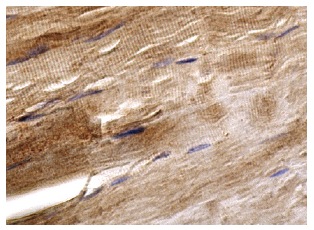
Immunoperoxidase staining of formalin fixed, paraffin-embedded human skeletal muscle tissue showing cytoplasmic staining of myocytes.| Product Name | GPR43 Antibody (H-120) |
|---|---|
| Antibody Type | Primary Antibodies |
| Antigen Alias | epitope corresponding to amino acids 61-180 mapping near the N-terminus of GPR43 of human origin |
| Conjugation | Agarose |
| Modification | Acetylated |
| Modification Notes | G protein-coupled receptors provide attractive targets for drug therapy due to the sheer size and diversity of ligands within this receptor family. G protein-coupled receptor (GPR) GPR41 and GPR43 are related members of a homologous family of orphan G protein-coupled receptors that are tandemly encoded at a single chromosomal locus in both humans and mice. GPR43 functions as a ligand for short chain fatty acids (SCFAs), notably acetate and propionate. Bacteria in the gut produce high concentrations of SCFAs, which are subsequently released in the bloodstream, where they exert cellular effects on blood leukocytes, including calcium release, ERK1/2 activation, and inhibition of cAMP accumulation. These effects indicate a role for GPR43 in the recruitment of leukocytes, particularly polymorphonuclear cells, to sites of bacterial infection. |
| Clonality | Polyclonal |
|---|---|
| Isotype | IgG |
| Host Species | Rabbit |
| Tested Applications | ELISAIFIHCIPWB |
| recommended for detection of GPR43 of mouse, rat and human origin by WB, IP, IF, IHC(P) and ELISA: |
|
| Species Reactivity | HumanMouseRat |
| Concentration | 1mg/ml |
| Purification | Affinity purified |
| Alternative Names | epitope corresponding to amino acids 61-180 mapping near the N-terminus of GPR43 of human origin |
|---|---|
| Tissue Specificity | epitope corresponding to amino acids 61-180 mapping near the N-terminus of GPR43 of human origin |
| Entrez Gene | 2867 |
|---|
Application
Immunoperoxidase staining of formalin fixed, paraffin-embedded human skeletal muscle tissue showing cytoplasmic staining of myocytes.| Application Notes | recommended for detection of GPR43 of mouse, rat and human origin by WB, IP, IF, IHC(P) and ELISA: |
|---|
| Form | Liquid |
|---|---|
| Storage Instructions | For short-term storage, store at 4° C. For long-term storage, aliquot and store at -20ºC or below. Avoid multiple freeze-thaw cycles. |
| Storage Buffer | phosphate buffered saline , pH 7.4, 150mM NaCl, 0.02% sodium azide and 50% glycerol. |


